What is a Yenko?
“Yenko” does not name one car, one company, or even one era of ownership. It names three genuinely different things: Don Yenko personally, and Yenko Chevrolet as a dealership, building and selling modified performance cars from 1965 through the early 1980s; a roughly quarter-century gap in which the name was not used on any new vehicle; and a modern, trademark-licensed product line that has no operational connection to Don Yenko or his dealership at all. Getting the year and the program right matters more with this name than with almost any other in the muscle-car era, because the build method itself — not just the trim level — changed from one year to the next.
Don Yenko and Yenko Chevrolet
Yenko Chevrolet operated at 575 West Pike Street in Canonsburg, Pennsylvania from its founding until Don Yenko sold the business in 1982.[26]
Don Yenko raced Corvettes at the regional and national SCCA level from 1957 onward, winning SCCA B-Production national championships in 1960 and 1961, and won the 1969 Citrus 250 at Daytona with co-drivers Paul Newman and Dickie Smothers.[28]
That racing background is the throughline for the rest of this guide. Yenko’s first performance-car program, the Corvair Stinger, existed to satisfy an SCCA homologation requirement so Yenko himself could legally race the car — selling the homologation-run cars to the public is what turned a racer’s need into a business.
Don Yenko died on March 5, 1987, in a Cessna 210 hard-landing accident near Charleston, West Virginia.[28]
Where it started: the Corvair Yenko Stinger (1965–1967)
The Yenko Stinger was a Chevrolet Corvair Corsa modified by Yenko Chevrolet specifically to satisfy SCCA production-class homologation, then sold to the public. The SCCA gave tentative approval in November 1965 on the condition that Yenko produce a minimum of 100 cars, and certified the Stinger into D Production on January 6, 1966.[21]
Dealer-built 427s: the 1967–1968 Yenko Super Camaro
General Motors did not offer an engine larger than roughly 400 cubic inches in the Camaro or the Chevelle during this period, commonly explained as protecting the Corvette’s position atop Chevrolet’s performance lineup. That restriction — not a lack of demand — is why a 427-cubic-inch Camaro did not exist as a factory order in 1967 or 1968.
Yenko instead ordered 396-cubic-inch Super Sport Camaros from Chevrolet’s Norwood, Ohio plant, then had his own mechanics remove the factory engine and install a 427 in its place.[11]
The factory era: 1969 COPO 9561 Camaro
Yenko, along with fellow dealer Fred Gibb of La Harpe, Illinois, recognized that this ordinary fleet mechanism could also be used to specify engines and equipment Chevrolet did not otherwise offer on a given model — including a big-block engine larger than a Camaro or Chevelle’s normal ceiling. That recognition is what makes 1969 different from 1967 and 1968: for the first time, the 427 itself came from Chevrolet, on the regular Norwood, Ohio assembly line, under Chevrolet’s own warranty.
How many of these cars Yenko actually sold, and how that figure relates to a second, more widely repeated number, is one of the most contested facts in this entire guide — and it is worth working through carefully rather than picking a number.
Yenko Super Chevelle (1969, COPO 9562)
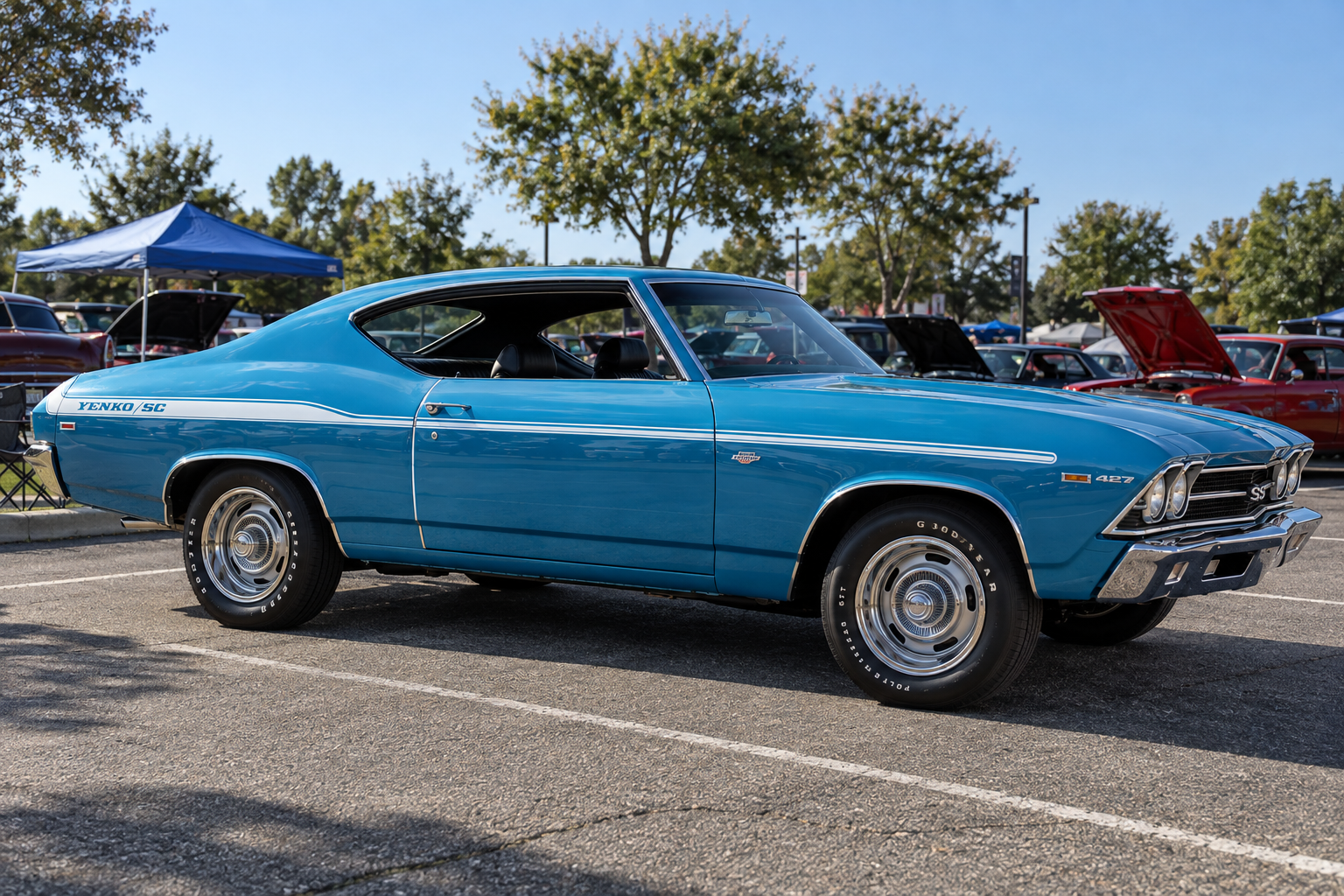
The Chevelle used its own distinct order code, COPO 9562, for the same factory-installed L72 427. Auction-house documentation for one specific chassis, titled “Documented Double COPO, 9562 427 and 9737 Yenko Sports Car,” independently confirms both codes on an individually identified car.[15][23]
Yenko Nova: two unrelated programs on one platform
The 1969 Nova and the 1970 Nova sold under Yenko’s name are not the same kind of car, one year apart — they were built by fundamentally different methods, for different reasons, and should not be read as one continuous “Yenko Nova” program.
For 1969, Yenko purchased factory Nova SS 396 cars and had his own mechanics perform a manual engine swap to a 427, sourced from Chevrolet’s full-size line — the same dealer-conversion method used on the 1967–68 Camaros, not the factory method used on the same year’s Camaro and Chevelle.[12]
One documented example is described as having “quite scary narrow tires, and small brakes” relative to its engine — a real limitation of fitting a full-size-car 427 into a compact-car chassis that was not otherwise upgraded to match.[12]
None of these four figures — 37, 30, 25, or “about 35” — should be read as the settled answer.
A separate account states “38 total” — 37 production cars plus one automatic prototype — without citing a source for either number, and a different, uncredited claim circulating elsewhere states that only about half of an intended 38 conversions were completed, or roughly 19. This guide does not trace the second claim to any named source and does not repeat it as fact.[13]
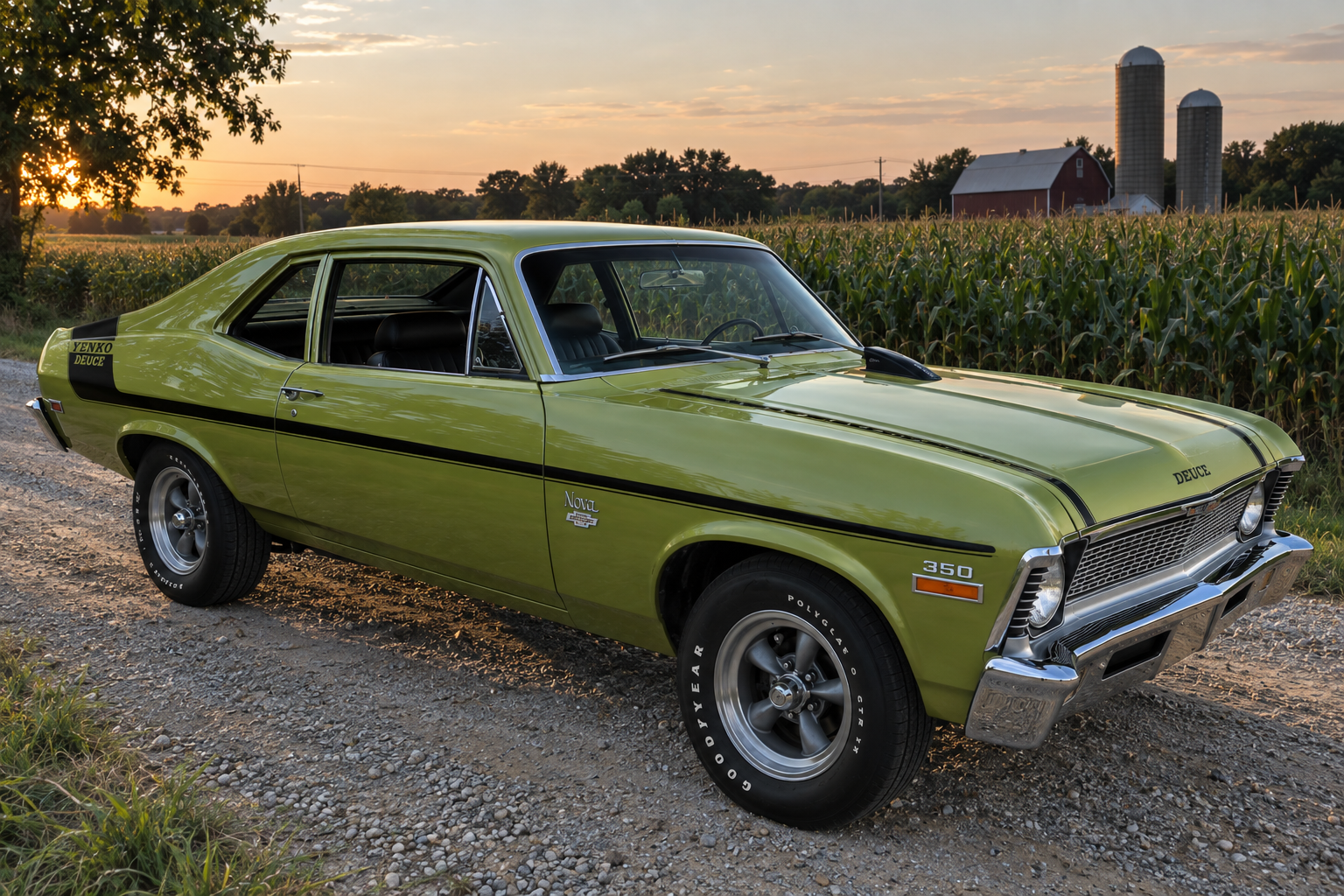
The 1970 Deuce Nova is a different program entirely, and a considerably better-documented one. Rising insurance surcharges on large-displacement engines were making a big-block Nova commercially difficult, so Yenko worked with Chevrolet to specify the high-output LT-1 350 small-block — the same engine used in the 1970 Z28 Camaro and Corvette — for a Nova special edition.
Each Deuce was assembled at the factory with the LT-1 engine, dual exhaust, power front disc brakes, heavy-duty springs, front and rear sway bars and an upgraded cooling system already installed under COPO 9010; Yenko’s dealership then added SS wheels, a Dixco hood tachometer and Yenko’s own badges, decals and stripes.[1]
Yenko Stinger Vega (1971–1973, COPO 9734AA)
As insurance surcharges and emissions and fuel-economy pressure squeezed the big-block programs, Yenko turned to Chevrolet’s new subcompact Vega as a smaller, more affordable performance platform.
The Stinger Vega’s factory order code was COPO 9734AA, listed on Chevrolet’s own documentation as “9C2AA2 — Special Vega Engine.”[8]
The 1981 Turbo Z and the end of the original era
Rising insurance premiums on high-displacement muscle cars, tightening federal emissions rules and growing fuel-economy pressure together brought Yenko’s big-block programs to a close by the early 1970s — the Stinger Vega’s own EPA-blocked turbo plan, above, is a specific, documented instance of that same regulatory pressure.
The last genuinely Don-Yenko-built car was the 1981 Turbo Z Camaro: a “blow-through” turbocharger feeding the stock carburetor on that year’s 175-hp 350 small-block, run at a maximum of 7 psi with no wastegate and paired only with the three-speed automatic — the only transmission offered with that engine that year. 19 total were built, of which 3 were the further-upgraded Turbo Z Stage II.[26]
Don Yenko sold the Canonsburg dealership in 1982, five years before his 1987 death.[26]
After Don Yenko: trademark, GMCI, and the licensed era
General Marketing Capital Incorporated, headquartered in Westminster, California, publicly announced its ownership of the Yenko trademark on October 21, 2009, timed to the 45th anniversary of the Yenko name.[27]
A related trademark registration, covering Yenko/SC automotive decals and stripe kits (Registration No. 5034138), is recorded as owned by General Marketing Capital, Inc.[31]
GMCI’s trademark position has been legally tested twice, and it prevailed both times — but each proceeding decided something narrower than “GMCI owns the Yenko name.”
In 2013, the USPTO Trademark Trial and Appeal Board dismissed a cancellation petition (Cancellation No. 92052197) brought by Terri Yenko Gould, named in the decision as executor of the estate of Donald Frank Yenko. The dismissal was on laches — a 14-year delay between notice and filing — and concerned a registration for the Yenko mark on toy cars specifically, not the automotive marks used on full-size vehicles today.[29]
In 2015, a federal consent judgment in the U.S. District Court for the Central District of California (Case No. 8:14-cv-01813) resolved General Marketing Capital, Inc.’s infringement claims against four named defendants in GMCI’s favor, with a permanent injunction barring those specific defendants from using the Yenko marks on motor vehicles.[30]
SVE, based in Toms River, New Jersey, began building officially licensed Yenko Camaros in 2015 after GMCI approached the company, later expanding to the Corvette, Silverado and other GM platforms.[33]
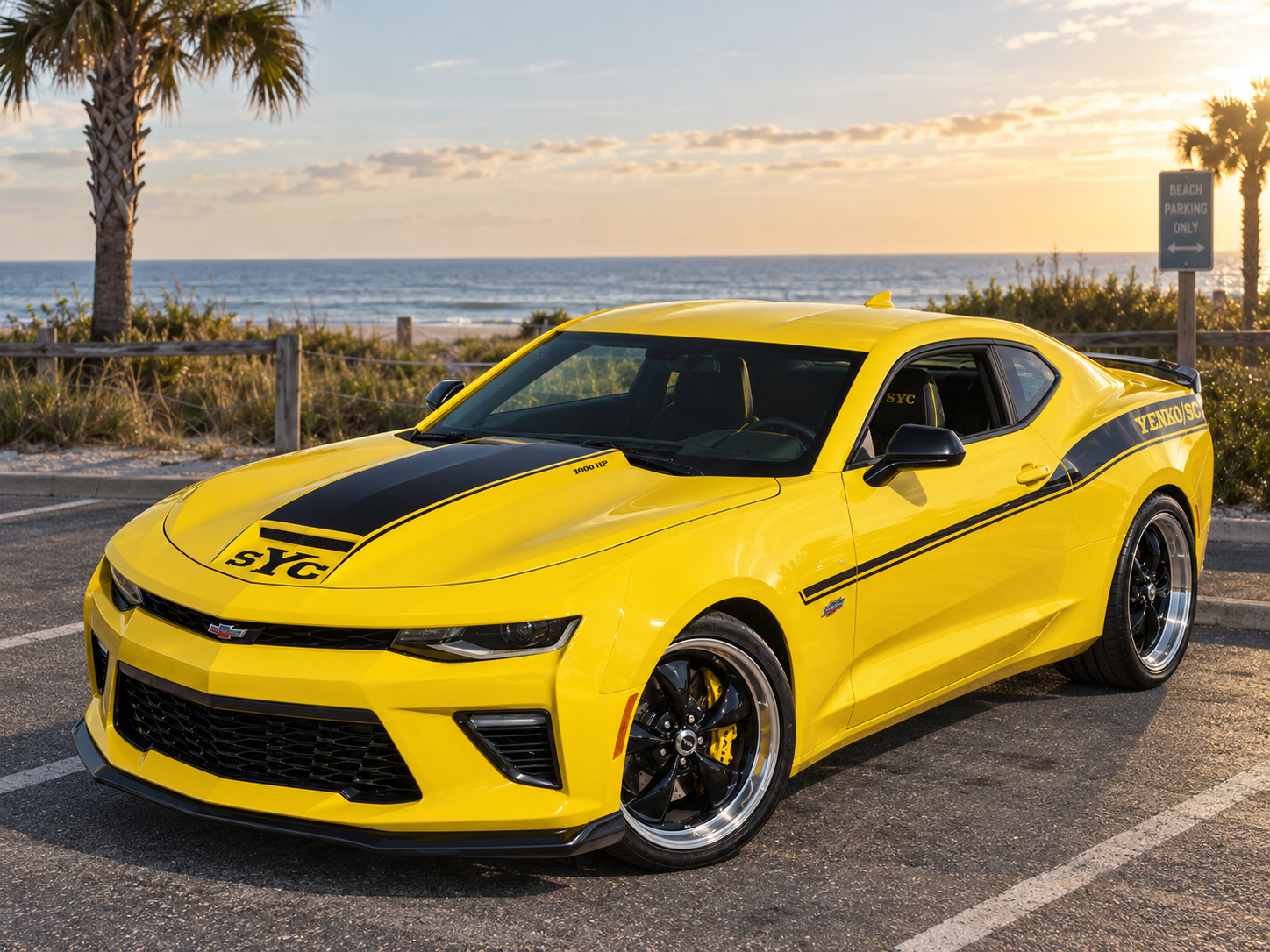
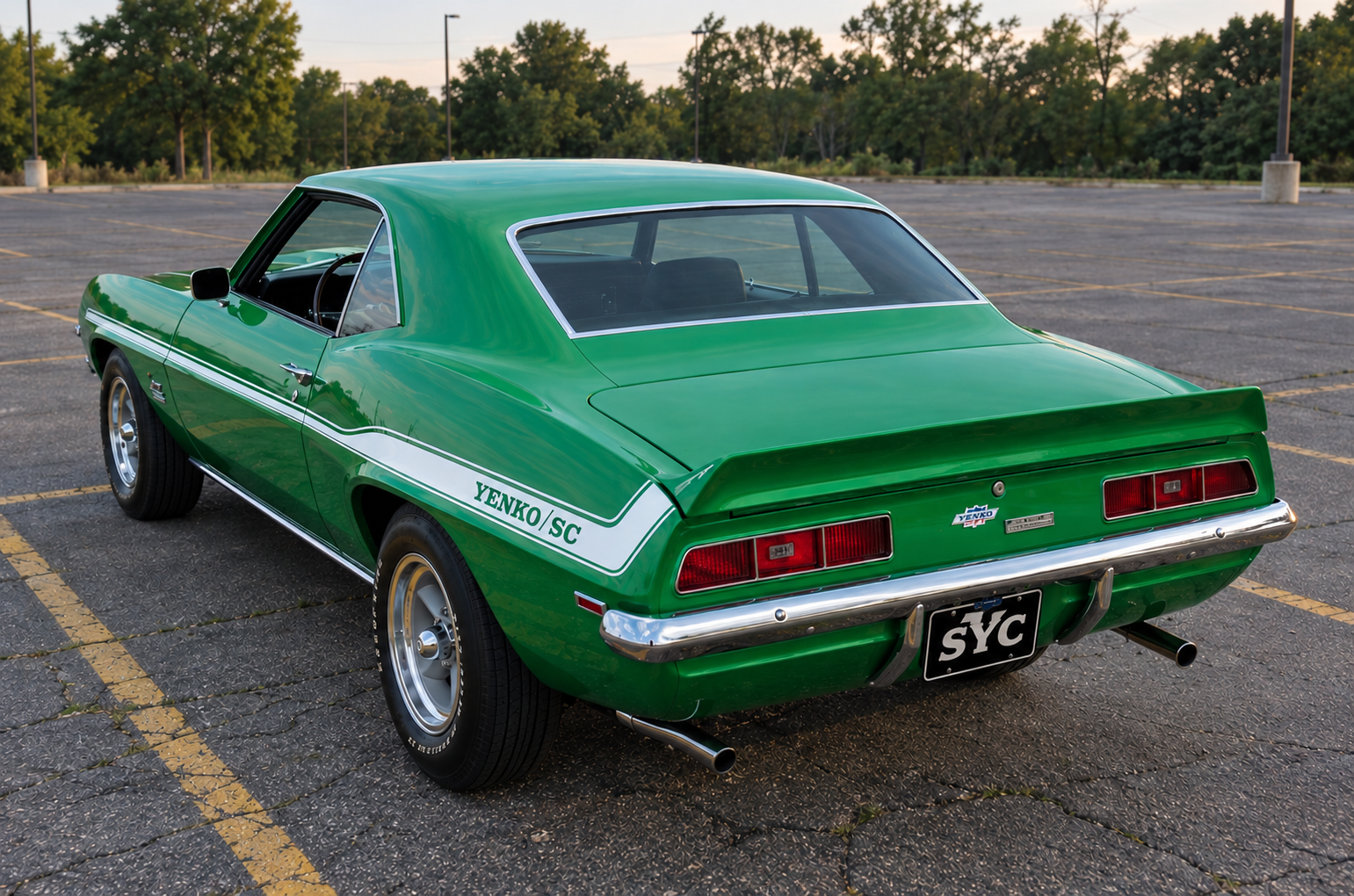
The car pictured above is a current SVE product built on a modern Camaro platform — a useful visual contrast with the 1969 Yenko/SC Camaro pictured at the top of this guide. The two share a name and a striping motif; they do not share a builder, a factory, or an era.
Brand New Muscle Car, based in Tulsa, Oklahoma, is a separate GMCI licensee building newly manufactured, 1968-specification “continuation” Yenko Camaros, announced in 2018 to mark the 1968 car’s 50th anniversary.[36]
Authentication and identification
A Camaro’s VIN encodes manufacturer, model, engine type (six-cylinder versus V8 only, not displacement), body style, model year and assembly plant — it does not encode COPO order status, and cannot by itself distinguish a COPO car from any other Camaro sharing the same body style, engine type, plant and year.[2]
The Fisher Body cowl tag documents build date, body-scheduling codes, interior trim, exterior paint and option codes. Beginning around December 1968, Norwood-built Camaros also began carrying an X-code identifying major trim and performance combinations — a system that did not exist on 1967 or 1968 cars.[2]
An X-code alone is weak evidence: approximately half of all X-coded 1969 Camaros are X11s, a code also used on ordinary small-block and six-cylinder cars, and COPO Camaros were often built in the same X11 or X44 body codes used for standard models.[2]
The Protect-O-Plate, a factory-issued plate documenting powertrain components and build month, is a genuinely useful cross-check specifically because it records data the cowl tag does not — but not every surviving plate carries the same information. A warranty-replacement plate, issued on a later change of ownership, records only the VIN, owner name and warranty period, with no drivetrain data at all, and reproduction Protect-O-Plates are a documented, active problem in the hobby, not a hypothetical one.
A build sheet, when one survives, documents the car’s originally ordered configuration in more detail than the cowl tag — but format varies by assembly plant, and the absence of a build sheet on a 55-plus-year-old car is common and unremarkable. Its presence, cross-matched against the VIN and cowl tag, is meaningfully strong corroboration.
A COPO order itself, when documentation survives, is tied to a dealer code and a batch quantity at the ordering stage — not to individual VINs. That is why COPO paperwork alone proves a batch was ordered, not that any one specific car was part of it; an individual car still has to be tied to that batch through VIN sequence, cowl-tag plant and date data, and dealer delivery records.
Badges, decals and stripe kits — the “sYc” headrest script, Yenko fender emblems, hood and quarter-panel stripe patterns — are consistently documented across every program in this guide, but every one of these items is also currently manufactured and sold as a licensed reproduction part. The same parts a legitimate restoration would use are equally available to build a tribute car, so badges and stripes cannot authenticate a car by themselves, however period-correct they look.
Reproduction trim tags, build sheets and dealer-style paperwork are a real, active commercial concern in this hobby, not a fringe risk, and there is at least one specific legal consequence attached to it: undisclosed sale of a reproduction trim tag is a documented crime in at least one U.S. state. Because reproduction documents are sometimes sold as matched sets, internal consistency between a car’s tag, plate and paperwork is not sufficient proof on its own — a sophisticated reproduction can make all three agree with each other while still being entirely fabricated.
Clones and tributes — ordinary Camaros, Chevelles and Novas fitted with reproduction Yenko stripes, badges and a 427 or larger engine swap — are a well-known, ongoing concern specifically for these cars, driven by the large price premium a documented original commands. How title-only or reconstructed-from-a-donor-body cars are formally treated by the specialist registries is not something this guide’s research was able to establish with a specific, citable policy — that remains an open question rather than a settled standard.
A complete, well-documented provenance chain brings several of these threads together: a VIN and cowl tag internally consistent with the claimed year, plant and engine type; for 1969-and-later cars, a code-bearing tag consistent with the claimed build; a Protect-O-Plate or build sheet independently corroborating the powertrain and options; a documented paper trail connecting the car to a specific Yenko dealer order or inventory entry; and a continuous, traceable ownership history with no unexplained gaps. A car missing several of these is not necessarily fake — but it represents a materially weaker case than one with all five, and treating authentication as accumulating evidence, rather than a single test, is the only approach that has actually held up across this guide’s own history.
Production numbers across every Yenko program
The pattern worth taking away from this table is not that Yenko’s history is unusually poorly documented — several of these figures are genuinely well-supported. It’s that “ordered,” “built,” “delivered,” “documented” and “announced” are different categories, and a real number that isn’t reconciled with its neighbor isn’t evidence that either figure is wrong.
Known-surviving counts exist for several of these programs — a handful of Yenko Camaros, a fraction of the 99 Chevelles, single-digit counts for the Nova and the wider Stinger Vega program — but this guide does not repeat any of them as an established figure. Every survivor count located in the approved research is single-sourced or not independently cross-checked against a named registry’s own published count, making it a meaningfully weaker category than the production and sales figures above.
Buying, owning, or researching a Yenko
CITED SOURCES
Sources
- COPO (Central Office Production Order) Camaros
Camaro Research Group · registry club · Accessed
COPO code definitions, dealer lists, and production totals for the 1969 COPO 9560 and 9561 Camaro, derived from statistical analysis, Fisher Body documentation, and GM assembly-manual cross-referencing.
Source issued
- Camaro Numbers: VIN, Cowl Tag and Protect-O-Plate
Camaro Research Group · registry club · Accessed
VIN structure, cowl-tag/X-code system, and Protect-O-Plate documentation for 1967–69 Camaros.
- Douglass COPO cars and the SYC inventory sheets
The Supercar Registry (yenko.net) · registry club · Accessed
Forum discussion among named registry contributors on why the Douglass-ordered COPO cars do not appear on Yenko’s own SYC inventory sheets.
- 1969 Yenko Nova production, per Vince Emme
The Supercar Registry (yenko.net) · registry club · Accessed
Forum thread relaying Vince Emme’s own account of the 1969 Nova list (37 cars, 25 converted), a separate 30-car figure from Emme’s own period magazine writing, and Don Yenko’s 1987 interview figure of “about 35.”
- 1969 Yenko Nova
The Supercar Registry (yenko.net) · registry club · Accessed
Documents that Ed Cunneen’s “COPO Connection” certification service ended in April 2006 and that its outstanding certificates should not be relied on; a disputed Cunneen-certified 427 Nova case.
- ’68 Yenko: Transplant vs. COPO
The Supercar Registry (yenko.net) · registry club · Accessed
Named-contributor debate over whether any 1968 Yenko 427 installation involved factory-level engine allocation.
- 1967 Yenko Camaro production 54?
The Supercar Registry (yenko.net) · registry club · Accessed
Named registry contributors disputing the commonly repeated 54-unit 1967 production figure as an undercount.
- Yenko Stinger Vega Archive
Ed Cunneen · registry club · Accessed
Year-by-year Stinger Vega production, colors and specification, built from Chevrolet invoices, window stickers, dealer correspondence and records from Yenko’s own crew chief Warren Dernosheck.
- 1969 Yenko Camaro SYC 427
Heacock Classic · technical specialist · Accessed
Documented COPO suboption codes, full specification and a color/transmission breakdown for the 1969 Yenko Camaro.
- 1968 Yenko Camaro: A COPO Converted
ClassicCars.com Journal · technical specialist · Accessed
Named-example (Ryan Snyder’s car) account establishing that the 1968 Yenko Camaro’s 427 was installed by Yenko’s own mechanics, not Chevrolet.
- 1967–1969 Chevrolet Camaro Yenko
Motogallery · technical specialist · Accessed
Year-by-year build-process and specification summary for the 1967–69 Yenko Camaro.
- 1969 Yenko Nova
Skillset Magazine · technical specialist · Accessed
Single documented example of the 1969 dealer-converted 427 Nova, including its full-size-engine source and stated real-world handling limitations.
- Rare Rides: The 1969 Yenko Nova S/C 427
Street Muscle Magazine · technical specialist · Accessed
States a 38-total figure (37 production plus one automatic prototype) and a 7-survivor estimate for the 1969 Nova, without a named registry citation for either.
- Rare Rides: The 1969 COPO L72 Chevelle
Street Muscle Magazine · technical specialist · Accessed
States a 323-unit all-dealer COPO 9562 total and describes Yenko proposing to purchase 99 Chevelles from the outset, rather than 100 minus a later cancellation.
- 1969 Yenko Chevelle L72 427/425HP
Supercars.net · technical specialist · Accessed
Documents COPO 9562 and 9737 equipment and the two transmission options offered on the 1969 Yenko Chevelle; does not state a specific automatic-transmission unit count.
- 1969 Chevelle COPO Information
ChevelleStuff.net · technical specialist · Accessed
Personal specialist compilation stating a 323-unit accepted COPO 9562 production run and 99 units built for Yenko, with its own noted internal inconsistency in the transmission-split sub-totals.
- 69 COPO Chevelle
Mac’s Webs · technical specialist · Accessed
Independent specialist compilation corroborating the 323-unit COPO 9562 total and the 99-unit Yenko figure.
- The Douglass-Yenko Camaro Controversy Explained
HotCars · technical specialist · Accessed
Account of Jack Douglass Chevrolet discovering factory COPO paperwork on a car Yenko was finishing, and describing the resulting Yenko/Douglass arrangement.
- No COPO: Rare, Unconverted 1969 Yenko Nova
Barn Finds · technical specialist · Accessed
States that Chevrolet declined to factory-install 427s in the Nova, so Yenko ordered bare Novas and converted them under its own Super Car program.
- Complete Guide to the Yenko Camaro
Yahoo Autos · technical specialist · Accessed
Cites a 54-unit 1967 production figure and a 64-unit (“though some claim 70”) 1968 figure from dealer records, and the best single narrative account of the Douglass-Yenko dealer episode.
- Yenko Stinger Specifications
CorvairCorsa.com · technical specialist · Accessed
Reproduces period Stinger Stage I–V performance-package specifications originally published by SPAN-INC, a period Chicago parts distributor.
- 1967–1969 Yenko and COPO Camaros
TireKickers · technical specialist · Accessed
Independently states a 68-unit 1968 production figure; also misidentifies the 1967 Yenko engine as the aluminum ZL-1, an error this guide does not repeat.
- Documented Double COPO, 9562 427 and 9737 Yenko Sports Car
Bonhams · auction reference · Accessed
Auction-house documentation for one specific chassis, confirming COPO 9562/9737 and describing Yenko’s order as 100 Chevelles with 99 actually built.
- Chevrolet Vehicles
American Muscle Car Museum · auction reference · Accessed
States a 323-unit total 1969 COPO 9562 Chevelle production figure.
- RM Sotheby’s
RM Sotheby’s · auction reference · Accessed
An Auburn Fall lot listing for a 1969 Yenko Chevelle citing a 323-unit COPO total, drawn from that car’s own Yenko Registry, Protect-O-Plate and delivery-schedule documentation.
- Yenko Memorialized With Plaque
Old Cars Weekly · period publication · Accessed
Coverage of the September 2023 Jefferson College Historical Society plaque dedication at the former Yenko Chevrolet site.
Source issued
- Plans Underway to Revitalize Yenko
Old Cars Weekly · period publication · Accessed
Coverage of General Marketing Capital Incorporated’s 2009 announcement of its Yenko trademark ownership.
Source issued
- Yenko Put the Pedal to the Metal on Life
Observer-Reporter · period publication · Accessed
Regional-newspaper retrospective on Don Yenko’s life, racing career and death.
Source issued
- TTAB Dismisses Yenko Cancellation Proceeding on Laches
The TTABlog · technical specialist · Accessed
Legal-specialist blog account of USPTO Trademark Trial and Appeal Board Cancellation No. 92052197, a proceeding over a toy-car trademark, dismissed on laches.
Source issued
- General Marketing Capital, Inc. v. Lynn Y. Zoiopoulos et al.
PacerMonitor · technical specialist · Accessed
Federal docket summary for C.D. Cal. Case No. 8:14-cv-01813, recording an October 22, 2015 consent judgment and permanent injunction against four named defendants.
- YENKO / SC Trademark
Justia Trademarks · technical specialist · Accessed
Legal-database listing for Registration No. 5034138 (Serial No. 86431834), an automotive decal/stripe-kit mark owned by General Marketing Capital, Inc.
- About SVE
Specialty Vehicle Engineering · manufacturer · Accessed
SVE’s own company history; does not mention Don Yenko, the Yenko family, or how SVE itself acquired rights to the name.
- 2024 Stage I/II/III 427 1500HP Yenko Camaro
Specialty Vehicle Engineering · manufacturer · Accessed
Current manufacturer specification and announced production-limit claims for the Stage I, II and III Yenko/SC Camaro.
Source issued
- Plan Underway to Build New Batch of ‘Original’ 1968 Yenko Camaros
Fox News · period publication · Accessed
Reports Brand New Muscle Car’s 2018 GMCI license to build newly manufactured, 1968-specification continuation Yenko Camaros.
Source issued