What is a Saleen Mustang?
“Saleen Mustang” does not describe one car, one engine or one horsepower figure. It describes more than four decades of a single company buying Ford Mustangs and rebuilding their suspension, aerodynamics, brakes, interior and — depending on the year and model — the engine itself, under one continuous badge that has covered everything from a bolt-on appearance package to a Saleen-built 620-horsepower engine.
The first Saleen Mustang, in 1985, brought Saleen aerodynamics, suspension, wheels, tires and interior changes to the car.[2]
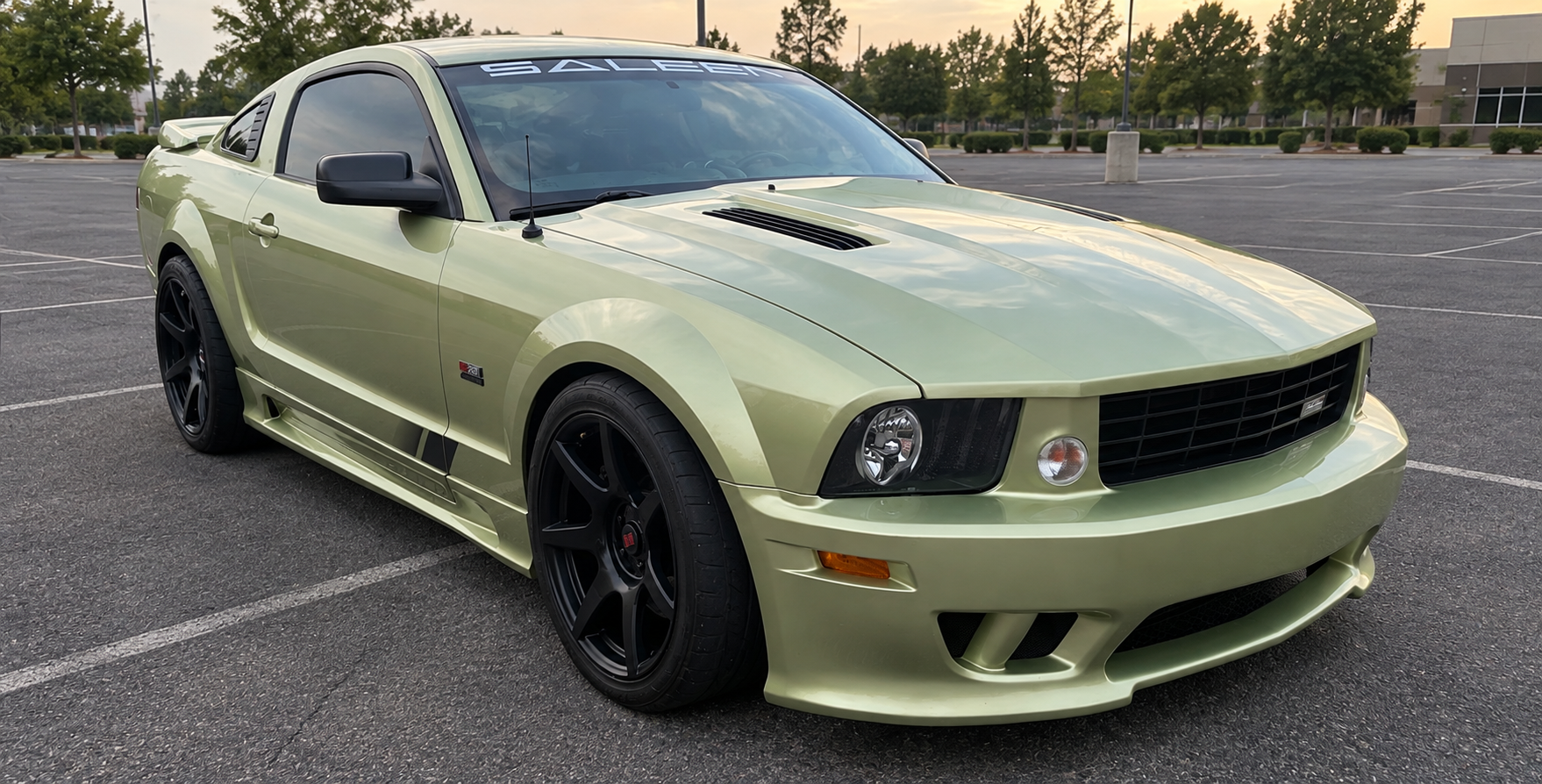
That range is exactly why the question that matters is not “what is a Saleen Mustang” but “which Saleen Mustang is this.” A naturally aspirated 1996 S281 and a 620-horsepower 2009 Dark Horse Extreme share a badge and very little else. The equipment fitted, the year it was built, and how completely Saleen documented that specific car all change the answer — and this guide is built to work through those distinctions in order: era by era, model by model, then down to the individual car.
Why Saleen existed
Steve Saleen founded Saleen Autosport on July 13, 1983, from his own dinner table at his home in Santa Rosa, California.[1]
Saleen turned professional as a Formula Atlantic driver in 1979, setting 13 lap records that year and finishing third in the series the following season.[5]
Saleen’s own account of the company frames its founding objective plainly: bringing race-proven performance to the street, by working with vendors to move race-tested components into cars sold through dealerships.[4]
That sentence is the throughline for almost everything in this guide. Saleen wasn’t badging a Mustang; it was putting a racer’s idea of what a Mustang’s chassis, brakes and aerodynamics should do onto a car regular buyers could order from a Ford dealer’s showroom floor. The company’s own racing didn’t stop once the road cars existed, either — it kept feeding back into them.
On October 10, 1986, a race-prepared Saleen Mustang won its class at the 24 Hours of Mosport, sponsored by General Tire and driven by Steve Saleen, Rick Titus and Lisa Caceras alongside IMSA drivers Skeeter McKitterick and Tom Winters and Formula One/Indy car driver Desiré Wilson.[3]
That win is sometimes dated to 1984 elsewhere online — almost certainly a mix-up with the year the first Saleen Mustang was built. Saleen’s own account, naming the sponsor and every driver, dates it to 1986.
A year earlier, in December 1985, Steve Saleen raced a black Mustang with two gold stripes at Riverside International Raceway — his home track, and the site of his first-ever race win twelve years before.[2]
The Fox-body: where the formula was created
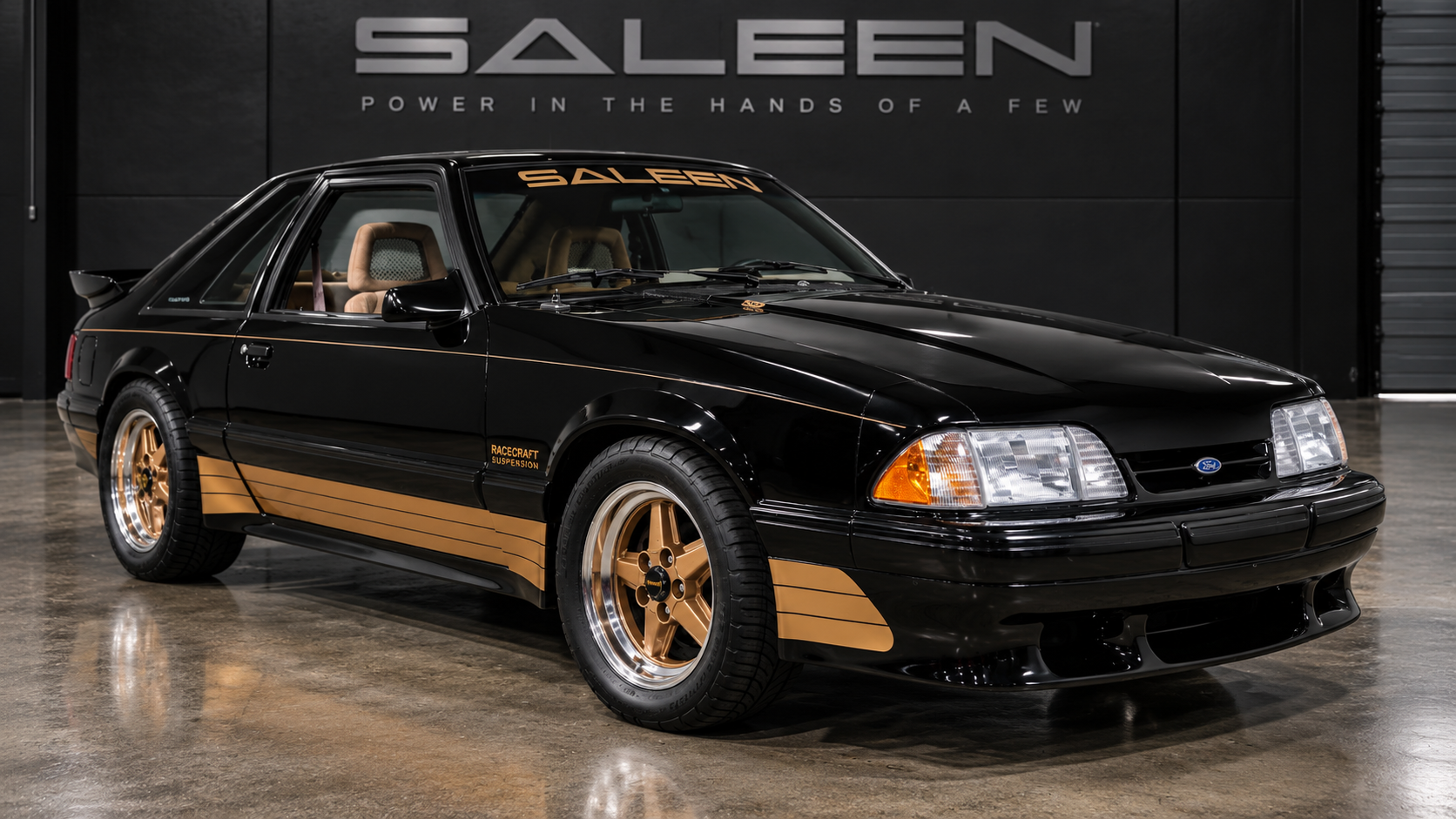
The Fox-body cars, built from 1984 through the early 1990s, are where Saleen worked out the formula every later car would follow: aggressive but road-usable suspension, better wheels and tires, aerodynamic bodywork, and a serial number tying the car back to Saleen’s own records. None of it stayed static — reading the factory equipment sheets year over year shows a company changing suppliers and adding equipment almost annually.
Saleen’s own history of the 1985 car describes an early quirk in that serialization: a secretary miscounted that year’s production and omitted vehicle number 6, and Saleen has never issued a #6 bumper number since.[2]
By 1987, Saleen’s factory equipment sheet documents identification in three places for the first time: a serialized number on the front bumper, a console plaque, and — new that year — an ID plaque riveted in the engine bay on the driver’s side apron. Four-wheel SVO-type disc brakes and a straight dual exhaust also appear for the first time on the 1987 sheet.[7]
The 1988 sheet documents its own running changes explicitly, marking several items “new for 1988”: a shock and strut supplier change to Monroe Formula GP, a Pioneer stereo replacing the previous Kenwood unit, and a redesigned front bumper molding.[7]
SSC, introduced in 1989, was Saleen’s most focused Fox-body car: a two-passenger design with the rear seat deleted for a built-in sound enclosure, Monroe Formula GP electronically adjustable struts and shocks, four-wheel SVO-type disc brakes with grooved rotors, and its own limited-edition serialization distinct from the standard cars.[7]
Four of the 1989 SSCs were built as demonstrators for Pioneer Electronics, serialized 89-0001P through 89-0004P, and deliberately did not carry the SSC engine package despite the badge — a materially different car from the 161 regular SSCs, tracked as its own line in Saleen’s production records.[10]
SA-10, the 10th-anniversary Speedster built in 1993, added an 8-pound-boost Saleen/Vortech centrifugal supercharger, 13-inch big brakes and three-piece 17-inch wheels to the formula — nine were built, all convertibles.[8]
The same year produced a single documented one-off, RRR: 576 horsepower from a Vortech-supercharged 302, carbon-fiber front fascia, hood and fenders, a six-point roll cage, and an interior that names a “McGuire-Nichols customized Tim ‘Tool Man’ Taylor integrated tool belt” — a direct link to actor Tim Allen, two years before Allen and Saleen formally named their SCCA World Challenge team the “Saleen/Allen ‘RRR’ Speedlab.”[9]
SSC, the Pioneer SSC demonstrators, SA-10 and RRR are useful in the same way: each shows how far Saleen was already willing to take a single year’s Mustang platform, from a two-passenger stereo showcase to a 576-horsepower one-off, while the ordinary production cars around them were still getting suspension and brake updates every year or two.
S351: when Saleen went far beyond the donor Mustang
S351, introduced for 1994 alongside the fourth-generation Mustang, was Saleen’s first car built around an engine Ford never offered in that chassis: a 351-cubic-inch Windsor V8, not the 5.0-liter (302) the Mustang GT actually used that year. It’s the clearest example in Saleen’s history of going beyond bolt-on tuning into building a genuinely different car.
The 1994 lineup named the 351-cubic-inch S351 alongside a separate model, SR — SR is not a trim of S351, but a distinct model introduced the same year.[6]
The naturally aspirated 1994 S351 used Saleen aluminum heads, a hydraulic roller camshaft and a Tremec five-speed manual, with an optional R-Code package adding a Vortech supercharger, larger brakes and a twin gauge pod.[12]
SR, sold the same year, added items S351 did not have: Saleen/Alcon four-piston brakes front and rear as standard equipment, magnesium wheels, a carbon-fiber hood, an FIA-style rear wing, a four-point chrome-moly chassis brace and a safety harness — a more track-focused car under a closely related name.[12]
Motor Trend’s January 1995 road test of the supercharged SR recorded 480 horsepower at 5,500 rpm and 487 lb-ft of torque, a 4.7-second 0–60 time and a 12.9-second quarter mile, calling it “the most powerful American car sold in dealer showrooms” at the time.[15]
By 1997, Saleen redeveloped the supercharged car’s driveline for the extra power: a Borg-Warner T56 six-speed — the same gearbox used in the Dodge Viper — replaced the earlier five-speed, and a Torsen limited-slip differential, developed jointly with Torsen Engineering, replaced the previous unit. Saleen stated the car made 510 horsepower that year.[13]
Motor Trend’s April 1996 test of the same supercharged car recorded a 5.2-second 0–60 time and a 13.4-second quarter mile at 119.3 mph — which the magazine called the fastest quarter mile it had tested from a production street car up to that point.[16]
One factory-documented paint option from this period is worth knowing about on its own: “Saleen Extreme Rainbow,” priced at $11,500 on a 1998 dealer order form for a car with a $56,990 base price — roughly a fifth of the entire car’s cost in paint alone.[13]
By 1999, Saleen’s own tabulated specification sheet records the supercharged S351 at 495 horsepower at 5,400 rpm and 490 lb-ft at 3,500 rpm, with a six-speed manual as standard equipment.[14]
S351’s original production run ended with the 1999 model year: the club’s production table shows S351 Coupe and Convertible entries only in the 1999 column, blank in every year after.[11]
Saleen’s own 2002 timeline entry frames the S281 Extreme as its new range-topping Mustang, arriving after S351’s discontinuation — though it does not give an exact final S351 build date.[22]
S281: the model that defined the next era
S281 arrived in 1996 alongside the existing S351/SR lineup, offered in both coupe and convertible form.[17]
The 1996 factory equipment sheet lists only bolt-on aerodynamic, suspension and interior parts — no engine-internal components at all — consistent with S281 launching as a lighter, less expensive alternative built on the Mustang’s unmodified 4.6-liter engine, not a Saleen-built powerplant like S351.[18]
The 1999 lineup, unveiled at Planet Hollywood, brought S281 and S351 together and introduced S281 SC — the first supercharged S281.[19]
By 2000, Saleen’s own specification table shows the gap plainly on one document: 285 horsepower and 315 lb-ft naturally aspirated, or 350 horsepower and 410 lb-ft with an optional Roots-style, water-to-water-intercooled supercharger.[20]
A dated Saleen press release announcing the 2002 lineup put real numbers on all three trims at once: base S281 at 285 horsepower and 320 lb-ft ($32,999 coupe); S281 Supercharged, now using a “Series II” supercharger, at 365 horsepower and 400 lb-ft ($39,299 coupe); and a new-for-2002 S281-E (Extreme), built around a Saleen-manufactured engine rather than the stock Ford block, at 425 horsepower at 6,400 rpm and 440 lb-ft at 4,000 rpm through a Saleen-designed six-speed manual, at $59,995.[21]
That’s the real difference between SC and Extreme in this era, and it’s bigger than a horsepower number: the Extreme wasn’t just a more boosted version of the SC’s engine, it was a different engine entirely, built by Saleen rather than modified from Ford’s block, paired with a stronger transmission Saleen designed itself.
Saleen’s own 2002 timeline entry ties the S281 Extreme’s launch to a new Twin Screw supercharger that year, following S351’s discontinuation.[22]
The 20th-anniversary SA-20 Speedster, offered only as a convertible in 2003 and limited to ten cars, used a Saleen Series IV screw-type intercooled supercharger for 375 horsepower — a different, lower-tier supercharger than the Extreme’s Series V unit that same period.[23]
Saleen’s 2004 specification table for the S281SC still lists a Series IV Twin Screw supercharger — 375 horsepower at 5,800 rpm and 415 lb-ft at 3,500 rpm — one year before the SC line moved to the newer Series VI unit for 2005.[24]
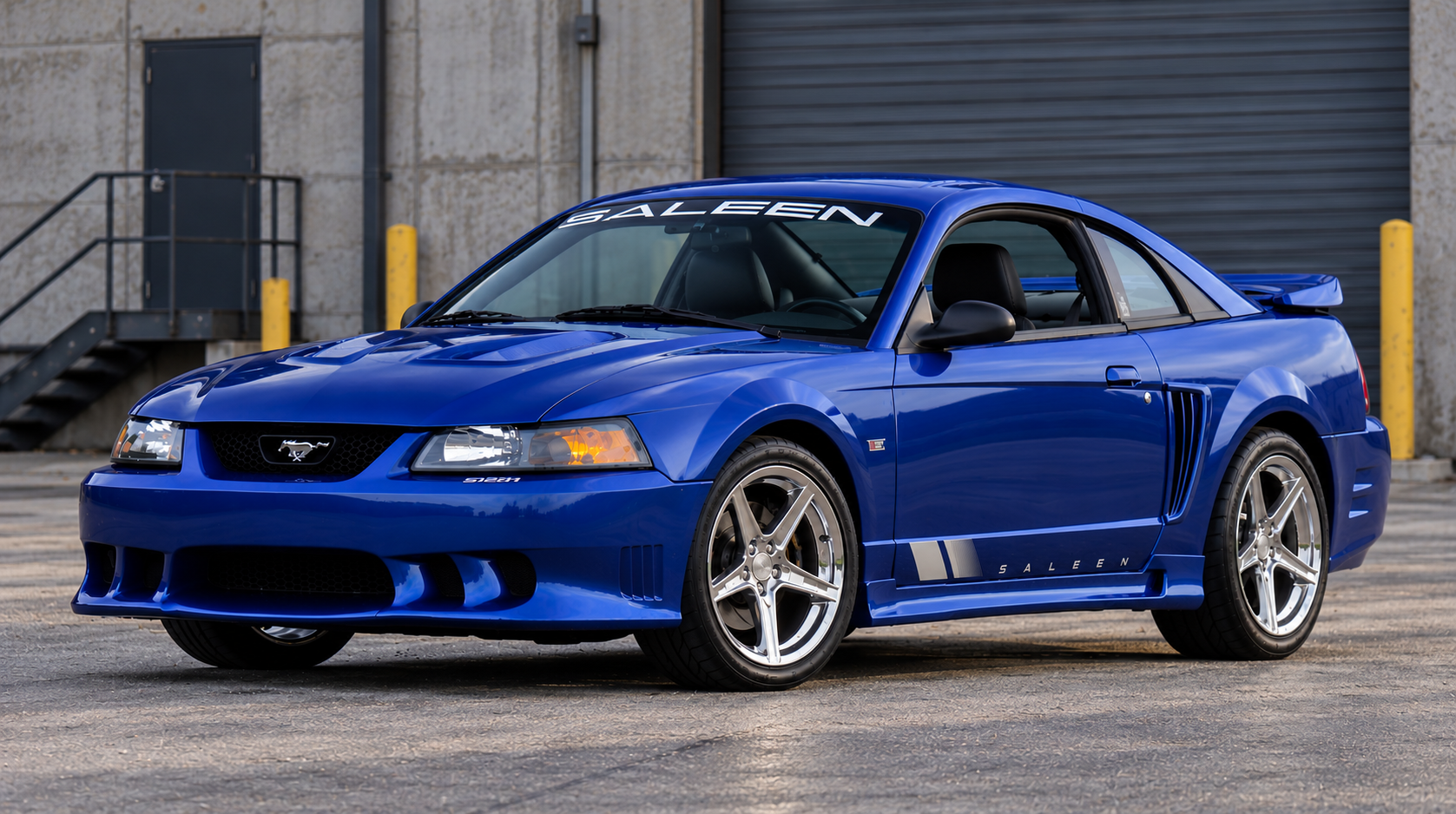
Rare configurations survive from this era at the individual-car level even where the aggregate production tables don’t break them out: one documented 2001 S281 SC Speedster carries Saleen’s own account that only twelve Mustangs total, across model years 1999 through 2002, were built with an optional Ford white leather interior — five of them in 2001, four of those five painted Oxford White.[25]
2005 and the S197 reset
Saleen’s announcement, filed under 2004, described the redesigned 2005 car’s Scenic Glass Roof coupe option and a new HID headlight system.[26]
A dated January 2005 Saleen press release put real numbers behind the redesign: a six-inch wheelbase extension, a completely redesigned MacPherson-strut front suspension, a new three-link rear axle with a Panhard rod rated four times stiffer laterally than before, a body 31 percent stiffer in torsion and 49 percent more resistant to bending, standard 20-inch wheels on 275/35ZR20 tires, and larger brakes — 12.4-inch front and 11.8-inch rear rotors.[27]
That same release priced the 2005 lineup by trim for the first time on one document: S281 3-Valve at 325 bhp and 340 lb-ft ($39,043); S281 SC at 400 bhp and 420 lb-ft, using a new Saleen Series VI integrated TwinScrew supercharger with two-stage water-to-air intercooling ($46,134, matching that year’s Corvette output); and S281 E, still finalizing its exact 2005 figures at the time of the release after making 445 bhp and 450 lb-ft the year before.[27]
Put together, the 2005 SC and Extreme shared the same basic supercharger, but the Extreme’s forged internals, standard six-speed manual, standard limited slip and standard four-piston front brakes made it a more thoroughly built car, not just a higher dyno number on the same parts. That distinction doesn’t automatically carry to other model years — always check the exact year’s literature — but it’s the clearest documented example of what buying “up” from SC to Extreme actually bought.
The 2007 Saleen/Parnelli Jones edition, unveiled in 2006 and drawing on the 1970 Boss 302 Parnelli Jones raced, was limited to 500 units — a figure Saleen’s own brochure and the club’s independently compiled production table both agree on exactly.[31]
That brochure documents a naturally aspirated 302-cubic-inch engine — 400 hp at 6,000 rpm and 390 lb-ft at 4,000 rpm — with forged pistons, rods and crank, a five-speed manual only, and an exclusive Grabber Orange livery with a black hood stripe and “302” side stripes, carrying facsimile signatures of both Steve Saleen and Parnelli Jones.[32]
SOEC’s production table separately records 500 completed S302 Parnelli Jones cars — the announced limit and the recorded build matching exactly, one of the cleanest documented production figures in this whole history.[11]
Saleen’s Heritage line paired retro styling with two very different engines under the same H281 prefix. The plain H281 Heritage 3-Valve, limited to 100 units, used a naturally aspirated 4.6-liter engine at 330 horsepower and 345 lb-ft; the H281 Supercharged Dan Gurney Edition, limited to 300 units and honoring Dan Gurney’s own 1969 Trans-Am Boss 302, used a Series VI TwinScrew supercharger for 465 horsepower and 425 lb-ft.[33]
The Dan Gurney car’s own brochure confirms the supercharged figures — 465 hp at 5,800 rpm and 425 lb-ft at 4,000 rpm — plus a Series VI Integrated Twin-Screw Supercharger, a five-speed manual with a 3.73 MaxGrip limited slip, and just three offered colors: Torch Red, Performance White and Vista Blue.[34]
The club’s production table shows how far apart “announced” and “built” can land within the same Heritage family: the plain H281 3-Valve reached 63 of its 100 planned units (52 coupes and 11 convertibles), while the supercharged Dan Gurney reached 68 of its 300.[11]
In 2008, Saleen offered a rarer version still: the H302 Dark Horse Extreme, combining Heritage bodywork with the S281/S302 Extreme’s 620-horsepower, Series VI screw-type supercharged engine and an upgraded SuperShaker hood scoop said to contribute an additional 0.5 psi of boost on its own.[35]
Period trade coverage dated October 13, 2008 named it plainly: “Saleen Dark Horse Extreme Edition,” priced at $89,995, with production beginning that November.[35]
An individually documented example carries the same full designation — “2009 Saleen H302 Dark Horse Extreme” — directly on its own vehicle record, along with a distinctive build-number suffix used only for this edition: “DH,” as in 09-0004DH.[36]
Saleen planned 25 coupes and 5 convertibles; the club’s production table records 8 completed — 6 coupes and 2 convertibles.[11]
How Saleen supercharging evolved
Saleen’s earliest documented supercharged package, on the 1993 SA-10, was a centrifugal Saleen/Vortech unit running 8 lb of boost; the same-year RRR one-off used a higher-boost Vortech “B” trim unit at 13.5 psi.[8]
S351 and SR carried a centrifugal Saleen/Vortech supercharger throughout their run, from 1994 through the car’s final 1999 model year, with output climbing from a Motor Trend-tested 480 horsepower in 1994 to a Saleen-stated 510 horsepower by 1997 without changing the basic supercharger architecture.[13]
A Roots-type design first appears on a Saleen Mustang on the 1998 SA-15 anniversary car — described as a “new Saleen ‘Roots’ Supercharger with Intercooler” — and reappears as the optional S281 SC supercharger in 2000, a water-to-water-intercooled unit distinct from the centrifugal Vortech design used on the contemporaneous S351.[20]
By late 2001, Saleen’s own press release names two different systems running at once: a “Series II” supercharger on the mainstream S281 Supercharged, and a materially larger “Series V screw-type” unit reserved for the new, Saleen-built S281-E engine.[21]
That tiering continued for several years: the 2003 SA-20 anniversary car and the 2004 S281SC both used a Series IV Twin Screw supercharger, one tier below the Series V fitted to the same-era Extreme.[23]
For 2005, Saleen moved both the SC and Extreme onto a new, shared unit — the Series VI Integrated TwinScrew Supercharger with a two-stage water-to-air intercooler and an integrated intake manifold and blower housing — differentiating the two trims by engine internals and equipment instead of supercharger tier.[28]
The same Series VI architecture, port-matched for further output, carried the 2008–2009 Dark Horse Extreme’s engine to 620 horsepower.[35]
Two things worth being careful about here. First, that Series numbering was never simply chronological — Series IV and Series V ran in Saleen’s lineup at the same time between 2001 and 2004, on different trims, and Series VI later unified trims that had previously used different tiers. Second, Series III isn’t documented anywhere in Saleen’s own factory literature found for this guide; it shows up only in unsourced enthusiast consensus online, and shouldn’t be repeated as a confirmed specification until a primary source for it turns up.
From the 2013 S302 Label cars onward, Saleen moved to a twin-screw supercharger described by displacement rather than a series number — see the next section — and current S650-generation cars use what Saleen describes as a 3.0-liter “inverted design” supercharger engineered to fit under the stock hood without cutting.
S302 and the Label system
Before the familiar three-way split, a 2012 Saleen (branded SMS Supercars, ahead of Steve Saleen’s 2012 reacquisition of the Saleen name) card offered “Black Label” content over either of two engines on the same document: a naturally aspirated 302 at 440 hp and 427 lb-ft, or a supercharged 302 SC at 575 hp and 590 lb-ft.[38]
The White/Yellow/Black three-tier structure as commonly understood dates to 2013: three separate factory cards, White Label naturally aspirated at 440 hp and 400 lb-ft, Yellow Label supercharged at 625 hp and 536 lb-ft, and Black Label — sharing the exact same 625 hp and 536 lb-ft as Yellow Label that year.[39]
That first year, Black Label was differentiated from Yellow Label entirely by chassis and equipment, not engine tune: Yellow Label used Saleen’s S1 suspension package, the same as White Label, while Black Label alone got the fuller S4 suspension along with additional aerodynamic and interior content.[41]
The pattern repeated for the S550-platform launch: Saleen’s dated 2015 factory document lists White Label at 450 hp and 410 lb-ft, and Yellow Label and Black Label identically at 640 hp and 565 lb-ft — again split by suspension hardware and aerodynamic/interior equipment rather than output.[42]
Black Label first gained an actual power advantage over Yellow Label in the dated 2016 document: White Label unchanged at 450/410, Yellow Label up to 715 hp and 595 lb-ft, and Black Label now ahead of it at 730 hp and 600 lb-ft.[43]
The 2017 document repeats the same 450/715/730 figures unchanged.[44]
Saleen’s dated 2018 document raises White Label to 475 hp and 430 lb-ft — but explicitly lists Yellow Label and Black Label output as “TBD” at the time of publication.[45]
That “TBD” is the actual, primary-sourced explanation for why other sources report inconsistent Yellow and Black Label horsepower for this generation — Saleen’s own factory document left the number unfinished when it went to print, and no later dated document closing that gap was found for this guide. Any figure above 730/600 for a Yellow or Black Label from this specific console generation should be treated as unconfirmed until a dated Saleen document supports it.
That 2018 document also reflects a real change to the donor Mustang itself: the engine is re-specified from “5.0L Ti-VCT” to “5.0L PFDI,” the manual transmission gains a “D4” suffix, and a new 10-speed automatic replaces the previous 6-speed — all tracking Ford’s own driveline update to the Mustang GT that year, documented directly in Saleen’s own equipment list.[45]
The George Follmer Edition, part of Saleen’s Heritage Collection and limited to 250 units, sat alongside this Label lineup in 2014: a naturally aspirated 302 at 495 hp, a six-speed manual, S4 suspension, and an exclusive Race Red livery with a black-and-white hood, roof and decklid reproducing George Follmer’s actual 1969 Boss 302 Trans-Am colors.[46]
The club’s production table records only 4 completed George Follmer editions against that 250-unit plan — the largest proportional gap between an announced limit and documented build found anywhere in this guide.[11]
The modern Saleen Mustang
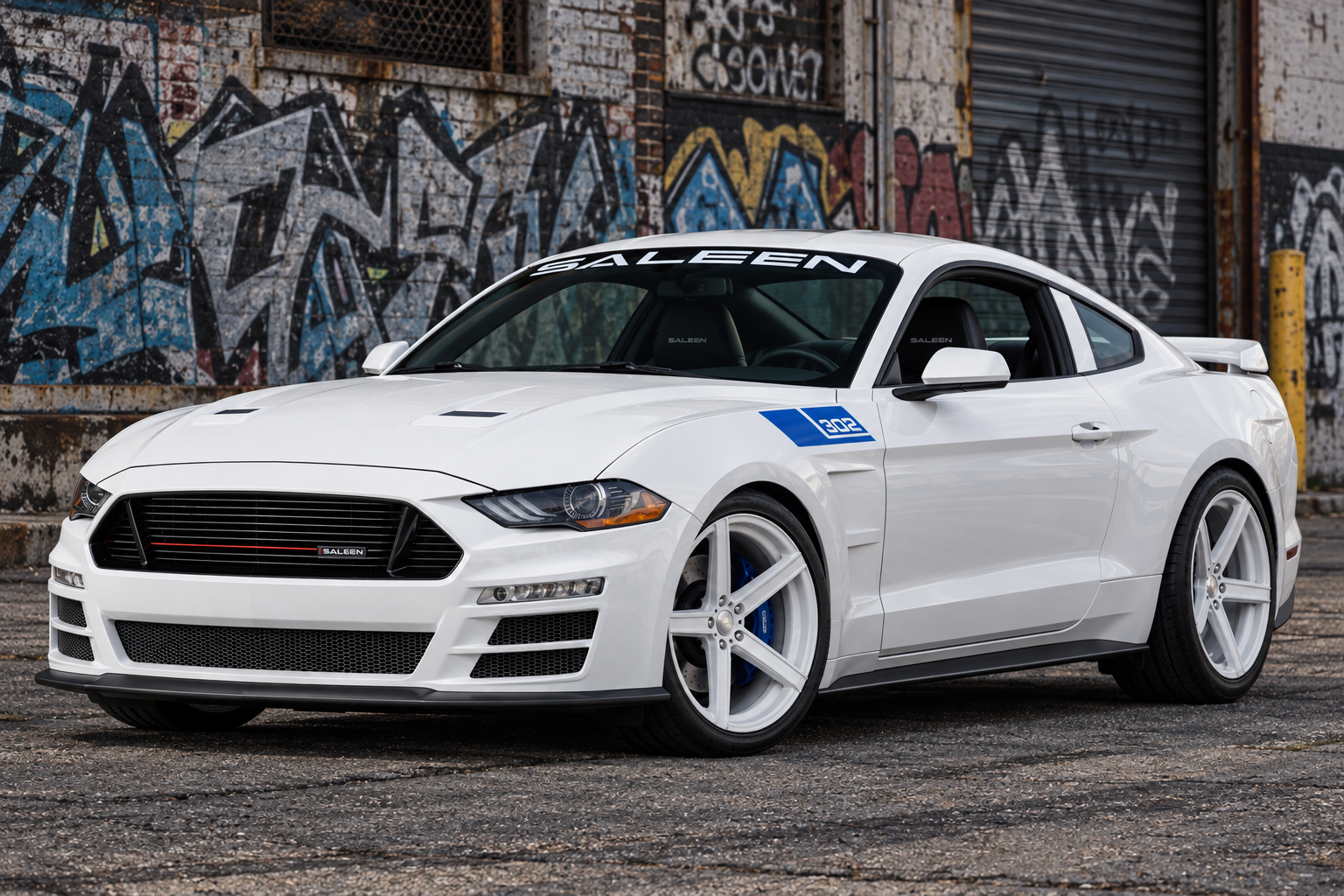
Black Label’s current output has moved more than once in a short window. Saleen’s own dated press release for the car’s debut, April 6, 2024, states 800 horsepower — “800 supercharged ponies” — starting at $108,990.[49]
Saleen’s current model page instead lists Black Label at 850 horsepower and 700 lb-ft.[48]
Read together, the most defensible explanation is that 800 hp was the as-debuted figure and 850 hp is a later running revision Saleen’s current pages now reflect — not two different cars or a live contradiction, since both figures come from Saleen’s own material, just at different dates. A separate 875-hp figure exists too, but it comes from the product page for Saleen’s own aftermarket Black Label supercharger kit, describing that component’s own rated ceiling — not a complete car’s factory-calibrated output. Don’t use 875 hp to describe what a finished Black Label Mustang makes unless a dated Saleen document for the complete car says so directly.
That kit page describes a 3.0-liter “inverted design” supercharger engineered to fit under the stock hood without cutting — the same basic architecture used across the current Yellow and Black Label cars, with Yellow Label’s own current page listing 775 horsepower.[50]
The philosophy underneath all of this hasn’t moved much since 1985: take a Ford Mustang, rebuild its suspension and aerodynamics with a Saleen-specific package, and — depending on how far up the lineup you go — rebuild the engine too. What has changed is how many distinct versions of that idea now exist at once, which is exactly why the year and the exact model still matter more than the badge.
How to identify a real Saleen Mustang
Start with the car’s paperwork, not just its badges. Saleen Mustangs are built from complete, VIN’d Ford Mustangs — every factory document reviewed for this guide describes Saleen’s own identity as numbers and plaques added to that car, never as a separate Saleen-issued vehicle identification number. That distinction matters: a genuine Saleen has a Ford VIN plus Saleen’s own serialization, not a Saleen VIN in place of Ford’s.
That serialization has been remarkably consistent since 1987: a serialized number on the front bumper, a plaque on the console, and a plaque riveted in the engine bay — three locations, all three appearing together on Saleen’s own factory sheets from the late Fox-body years through the 2007 Parnelli Jones brochure and beyond.[7]
Some limited editions carry their own build-number suffix on top of that scheme — the 2009 Dark Horse Extreme, for example, is documented with build numbers ending in “DH,” as in 09-0004DH, tying an individual car directly to its edition.[36]
Saleen’s current process for verifying a car uses the same two pieces of information a buyer should already be recording: the VIN and the Saleen bumper number, which Saleen checks against its own production archive to issue a Letter of Authenticity — though Saleen’s own product page notes a buyer should already have confirmed authenticity before ordering one.[51]
Reproduction Monroney window stickers are available directly from Saleen for 1996-to-current cars, printed on 11-by-17 card stock through 2009 and on 8.5-by-11 sticker paper from 2009 on — a small, dateable detail worth checking against the physical format of a sticker someone claims came with an older car.[52]
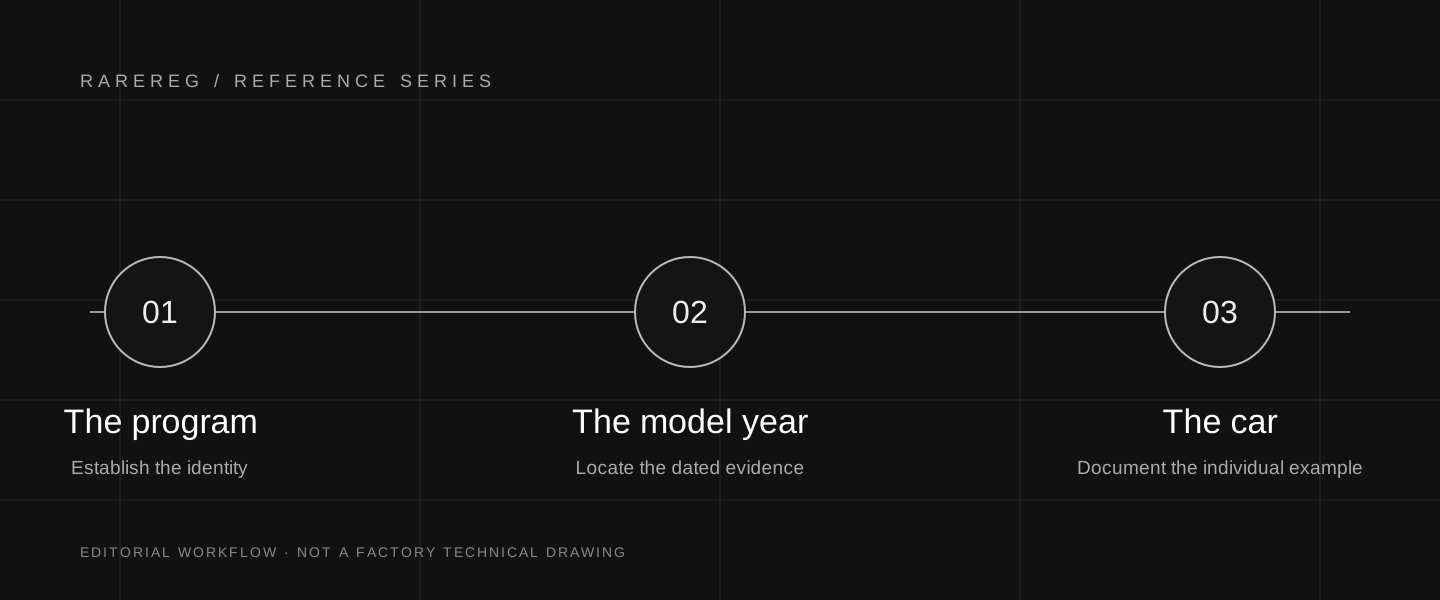
These are questions to take to the seller, a marque specialist, or Saleen itself — not a complete authentication checklist on their own. Keep full VINs, owner identities and private documents out of any public vehicle history you publish.
Production numbers and rarity
SOEC organizes Mustang production by year, program and body style, with its own repeated notes that incomplete totals and blank or “X” cells are not the same thing as zero production.[11]
Some of the most granular production detail survives only in individual cars’ own documentation rather than any published table — one 2001 S281 SC Speedster’s own record states that just twelve Mustangs, across four model years, were built with an optional Ford white leather interior.[25]
That’s the honest shape of Saleen production research: strong, cross-checked figures exist for plenty of named editions, real gaps exist for entire model years (2014 and 2015–2017 both carry the club’s own “incomplete totals” warnings), and the most specific color- or option-level breakdowns tend to survive in a specific car’s own paperwork rather than in any public table. A number that isn’t published isn’t zero — it’s unpublished, and worth asking the seller or Saleen directly to fill in with the actual documentation for that car.
Buying or owning a Saleen
Look past the model name and spend time with the individual car. Ask the seller to separate what is documented, what has been modified, and what still needs checking — the history above shows exactly how much can differ between two Saleens that look nearly identical.
CITED SOURCES
Sources
- 1983: Birth of Saleen Autosport
Saleen Automotive · manufacturer · Accessed
Company formation only; not the start date of every vehicle program.
- 1985: Saleen Mustang
Saleen Automotive · manufacturer · Accessed
The 1985 program description, the omitted-number-6 story and the Riverside race entry.
- 1986: Sports Car Club of America
Saleen Automotive · manufacturer · Accessed
Names the drivers, sponsor and date of the Mosport class win; the primary date for this event.
- Steve Saleen
Saleen Automotive · manufacturer · Accessed
Company biography of Steve Saleen; his stated founding objective, not an interview transcript.
- Corporate History
Saleen Owners and Enthusiasts Club · registry club · Accessed
Club-compiled corporate timeline: racing background, ASC merger, Michigan consolidation, 2009 asset sale and the 2012 reacquisition.
- Saleen timeline: 1988–1999 entries
Saleen Automotive · manufacturer · Accessed
Selected entries for SSC, S351, SR, SA-10 and SA-15; not a complete variant register.
- 1989 Saleen Mustang SSC: Features and Specifications
Saleen Autosport · factory literature · Accessed
Period factory equipment sheet; lists equipment, not dyno figures.
- 1993 Saleen Mustang SA-10: Features and Specifications
Saleen · factory literature · Accessed
Period factory equipment sheet for the 10th-anniversary Speedster.
- 1993 Saleen Mustang RRR: Features and Specifications
Saleen · factory literature · Accessed
Period factory equipment sheet for the individually documented RRR car.
- Signature & Special Edition Production
Saleen Owners and Enthusiasts Club · registry club · Accessed
Club register of small named editions, including the Pioneer SSC demonstrators.
- Mustang Production
Saleen Owners and Enthusiasts Club · registry club · Accessed
Selected year/body-style entries and program labels. Incomplete-total footnotes and blank or “X” cells are not confirmed zero, and club-reported figures are not a new factory certification.
- 1994 Saleen Mustang S351: Features and Specifications
Saleen · factory literature · Accessed
Period factory equipment sheet for the naturally aspirated S351 and its R-Code/T-Code options.
- Saleen S351-R Technical Highlights
Saleen Performance · factory literature · Accessed
A 1997-dated technical/marketing document (hosted at this URL); covers the Borg-Warner T56 and Torsen changes and a period competitive comparison table effective 10/01/97.
- 1999 Saleen S351: Specifications
Saleen · factory literature · Accessed
Full tabulated factory specification sheet for the S351’s final model year.
- Motor Trend: 1994 Saleen SR Road Test Review
Motor Trend · period publication · Accessed
Period road test of the supercharged S351 SR; tested figures, not Saleen-advertised figures.
Source issued
- Motor Trend: 1996 S351 Road Test Review
Motor Trend · period publication · Accessed
Period road test of the R-Code S351; tested figures, not Saleen-advertised figures.
Source issued
- 1996: Saleen Mustang
Saleen Automotive · manufacturer · Accessed
S281 introduction and the body styles described in that entry; no later-year applicability implied.
- 1996 Saleen Mustang S281: Features and Specifications
Saleen · factory literature · Accessed
Launch-year S281 equipment sheet; no engine-internal parts are listed.
- 1999: Saleen Mustang
Saleen Automotive · manufacturer · Accessed
1999 S281/S351 unveiling and S281 SC introduction.
- 2000 Saleen S281: Specifications
Saleen · factory literature · Accessed
Full tabulated sheet comparing the naturally aspirated and Roots-supercharged S281 on one document.
- Power and Refinement: Cornerstones of Expanded 2002 Saleen Model Line-Up
Saleen · factory literature · Accessed
Dated press release naming Series II and Series V superchargers and separate S281/SC/Extreme pricing.
Source issued
- 2002: Saleen Mustang
Saleen Automotive · manufacturer · Accessed
S281 Extreme introduction following S351 discontinuation and the Twin Screw supercharger debut. Does not establish the last S351 build date.
- 2003 Saleen SA-20: Specifications
Saleen · factory literature · Accessed
Period factory document for the 20th-anniversary Speedster.
- 2004 Saleen S281SC: Specifications
Saleen · factory literature · Accessed
Full tabulated factory specification sheet.
- Closer Look: S281 SC Speedster (01-0643) Is a Dream Come True
Saleen Owners and Enthusiasts Club · registry club · Accessed
Individually documented 2001 car; source of the white-leather-interior rarity figures for that period.
- 2004: Release of the 2005 Saleen Mustang
Saleen Automotive · manufacturer · Accessed
Distinguishes the 2004 release announcement from the redesigned 2005 model; covers the coupe Scenic Glass Roof option and HID headlights.
- Spectacular New Saleen S281 Mustang Hits the Streets
Saleen · factory literature · Accessed
Dated press release covering the redesigned chassis and separate 3-Valve/SC/Extreme pricing and output.
Source issued
- 2005 Saleen S281 SC: Specifications
Saleen · factory literature · Accessed
Full tabulated factory specification sheet; performance figures are marked “est.” by Saleen.
- 2005 Saleen S281 E: Specifications
Saleen · factory literature · Accessed
Full tabulated factory specification sheet; performance figures are marked “est.” by Saleen.
- Saleen timeline: 2000–2006 entries
Saleen Automotive · manufacturer · Accessed
The 2005 lineup entry names S281 3-V and Supercharged; the 2003 entry documents SA-20.
- 2006: Saleen/Parnelli Jones Edition
Saleen Automotive · manufacturer · Accessed
The 2006 entry describes the 2007 model; no production quantity or mechanical specification is inferred from this entry alone.
- Saleen/Parnelli Jones Limited Edition Brochure
Saleen · factory literature · Accessed
Retail brochure stating “Limited Edition – 500 Units” and full factory specifications.
- 2007 Saleen H281 Heritage 3-Valve: Order Guide
Saleen · factory literature · Accessed
Dealer order guide stating the 100-unit limited edition and full factory specifications.
- The Gurney Signature Edition
Saleen, Inc. · factory literature · Accessed
Retail brochure stating “Limited Production Only 300 Units” and full factory specifications.
- Saleen Dark Horse Extreme Edition
AutoWeek · period publication · Accessed
Period trade-press coverage naming the edition, its price, production start and core specification.
Source issued
- Dark Horse Edition (09-0004DH) Offered on eBay
Saleen Owners and Enthusiasts Club · registry club · Accessed
Individually documented car whose own record states the designation “2009 Saleen H302 Dark Horse Extreme” and the DH build-number suffix.
- Saleen timeline: later programs
Saleen Automotive · manufacturer · Accessed
2011 302, 2013 351, 2014 George Follmer, SA-40 announced limit and S650 White Label. Event/model years and announced/completed quantities remain separate.
- Steve Saleen Presents SMS 302 • 302SC Black Label
SMS Supercars · factory literature · Accessed
Pre-2013 factory card offering Black Label content over either a naturally aspirated or supercharged engine.
- 302 White Label
Saleen Automotive, Inc. · factory literature · Accessed
Factory specification card for the first year of the three-way White/Yellow/Black split.
- 302 Yellow Label
Saleen Automotive, Inc. · factory literature · Accessed
Factory specification card for the first year of the three-way White/Yellow/Black split.
- 302 Black Label
Saleen Automotive, Inc. · factory literature · Accessed
Factory specification card; identical output to the 2013 Yellow Label, differentiated by suspension and equipment.
- 2015 Features & Specifications: 302
Saleen · factory literature · Accessed
Dated factory document comparing White, Yellow and Black Label on one table.
Source issued
- 2016 Features & Specifications: 302
Saleen · factory literature · Accessed
Dated factory document comparing White, Yellow and Black Label on one table.
Source issued
- 2017 Features & Specifications: 302
Saleen · factory literature · Accessed
Dated factory document comparing White, Yellow and Black Label on one table.
Source issued
- 2018 Features and Specifications: 302
Saleen · factory literature · Accessed
Dated factory document; leaves Yellow and Black Label output as “TBD” at publication.
Source issued
- George Follmer Edition: Heritage Collection
Saleen Automotive, Inc. · factory literature · Accessed
Factory specification card stating “Limited Edition – 250 units” and full specifications.
- 2015: S302 Black Label Mustang
Saleen Automotive · manufacturer · Accessed
Event year comes from the heading, not the webpage date displayed below it.
- 302 Models
Saleen Automotive · manufacturer · Accessed
Current model names, horsepower and pricing at access time. Current specifications are not applied to earlier cars.
- Saleen Debuts the 2024 800hp 302 Black Label Mustang at MCA 60th Anniversary
Saleen Automotive · manufacturer · Accessed
The as-debuted output and starting price for the current-generation Black Label.
Source issued
- Saleen Supercharger: 2024+ Mustang S650 Black Label
Saleen Automotive · manufacturer · Accessed
A supercharger kit’s own rated ceiling output, not a complete-car factory figure.
- Saleen Vehicle Letter of Authenticity
Saleen Automotive · manufacturer · Accessed
Describes the current VIN-and-bumper-number Letter of Authenticity process.
- Saleen Monroney Window Sticker
Saleen Automotive · manufacturer · Accessed
Describes reproduction window-sticker availability and format by era.
FROM THE REGISTRY
Registered vehicles
Public Saleen Mustang examples connect this guide to individual cars. These are individual vehicle listings, not proof of total production or a certification of authenticity.
RAREREG #45
2026 Ford Mustang Saleen S302 Yellow Label
RAREREG #44
2005 Ford Mustang Saleen Saleen

RAREREG #27
2007 Ford Mustang Saleen S281 Supercharged
RAREREG #2
1989 Ford Mustang Saleen Saleen
RAREREG #3
1997 Ford Mustang Saleen S351 Speedster

RAREREG #1
2005 Ford Mustang Saleen S281 Supercharged
FROM THE MARKET