The Demon brief
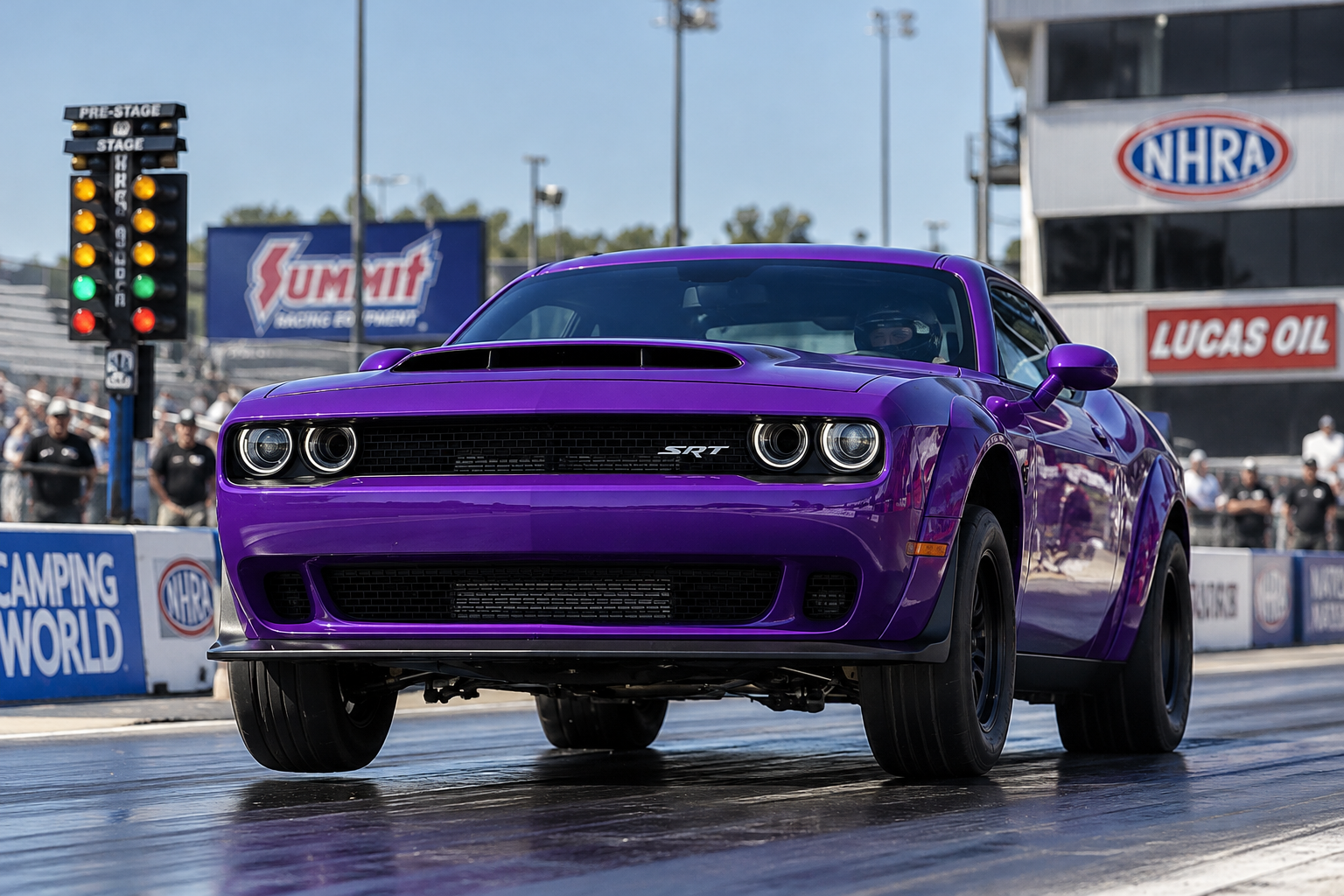
The most revealing part of a modern Demon is the moment before it moves. The engine is already loaded, the rear tires are prepared, and the driver is managing a launch rather than simply flooring the accelerator. Horsepower supplies the headline. The equipment that makes that horsepower usable supplies the story.
Dodge used the name for a compact performance model long before it appeared on a supercharged Challenger. Those cars share an attitude, not a continuous chassis lineage. The early Demon offered accessible small-block performance. The modern editions made drag-strip preparation a showroom specialty, with fuel strategies and documentation that demand considerably more attention than the badge.
1971–1972: the Dart-family original
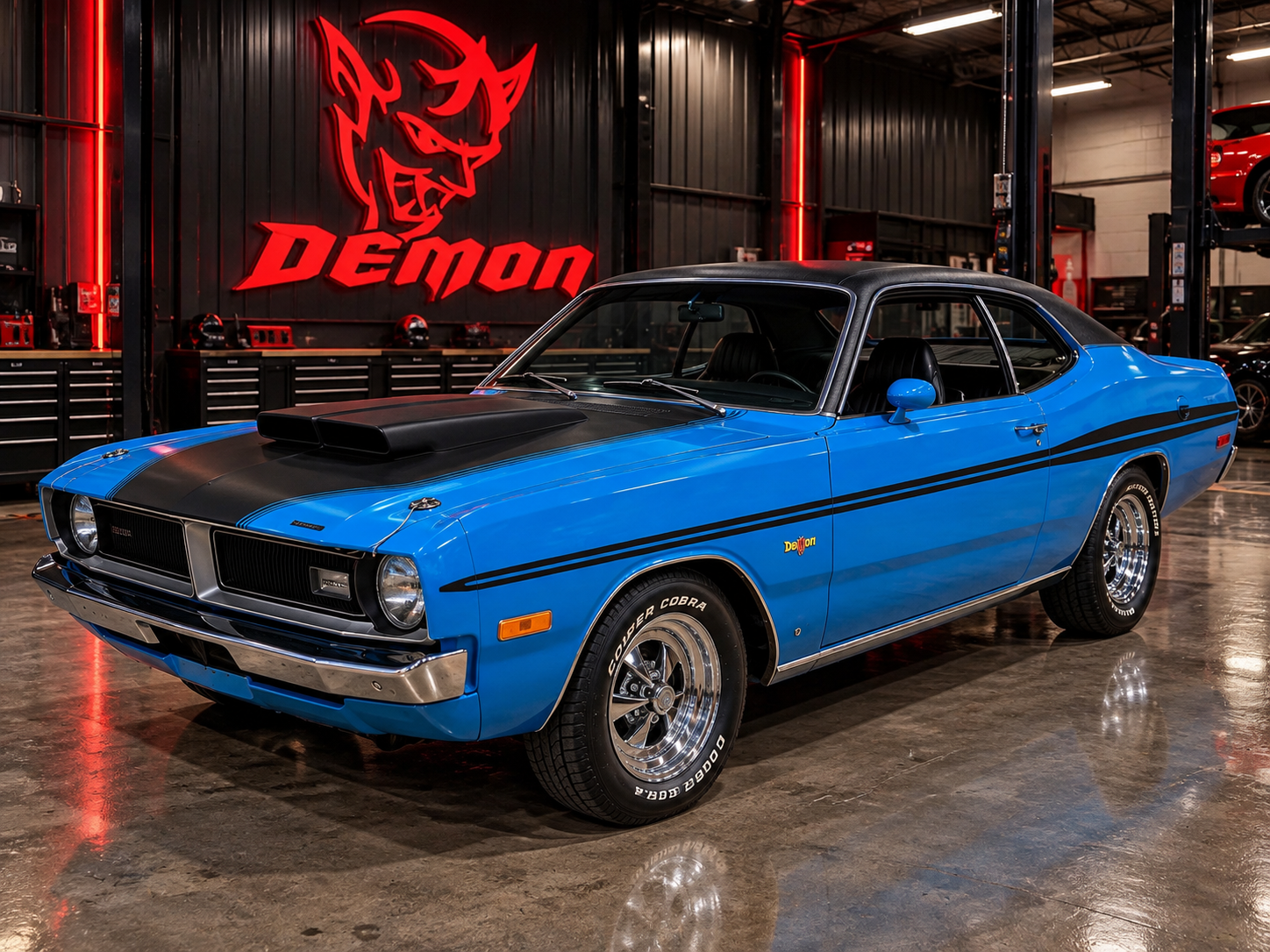
The 1971 Demon combined the Plymouth Duster’s semi-fastback A-body shell with Dart front styling and Dodge rear treatment. Ordinary Demons offered 198- and 225-cubic-inch Slant Six engines and a 318 V8; Demon 340 was the performance model.[1]
Dodge’s retrospective lists 275 hp for the 1971 340 and 240 hp for 1972, alongside reduced compression for the later engine. These years span the gross-to-net rating transition as well as real engine changes, so the numbers are not a clean same-method measurement of power lost.[1][22]
The period Scat Pack brochure lists a floor-shifted three-speed manual, Rallye suspension, heavy-duty torsion bars, springs and shocks, dual exhaust and 10-inch drum brakes. It was a compact performance package built around contemporary equipment, not an early version of the Challenger drag car.[2]
The name disappeared for 1973 as the fastback became Dart Sport. Dodge records complaints about the devil-themed name and advertising. That supports the backlash account, without establishing religious objections as the sole commercial reason for renaming. The underlying car continued.[1]
A six-cylinder example is still a genuine Demon. A restored 340 deserves authentication beyond its graphics. In these cars, the engine specification and original documents matter more than a familiar cartoon. Substituting a powerful engine may improve a car’s performance; it does not retrospectively change what Dodge built.
2007: a different Demon idea
The name also appeared on a roadster concept shown at Geneva in 2007. DodgeForum’s later account describes seeing it in the manufacturer’s historical collection. It was a nonproduction sports-car proposal, not a missing production generation between the Dart and Challenger.[21]
That detour is useful context. A revived name can carry several proposed identities before one reaches customers. It should not be counted in production totals for either Challenger edition.
2018: a Challenger built around the first sixty feet
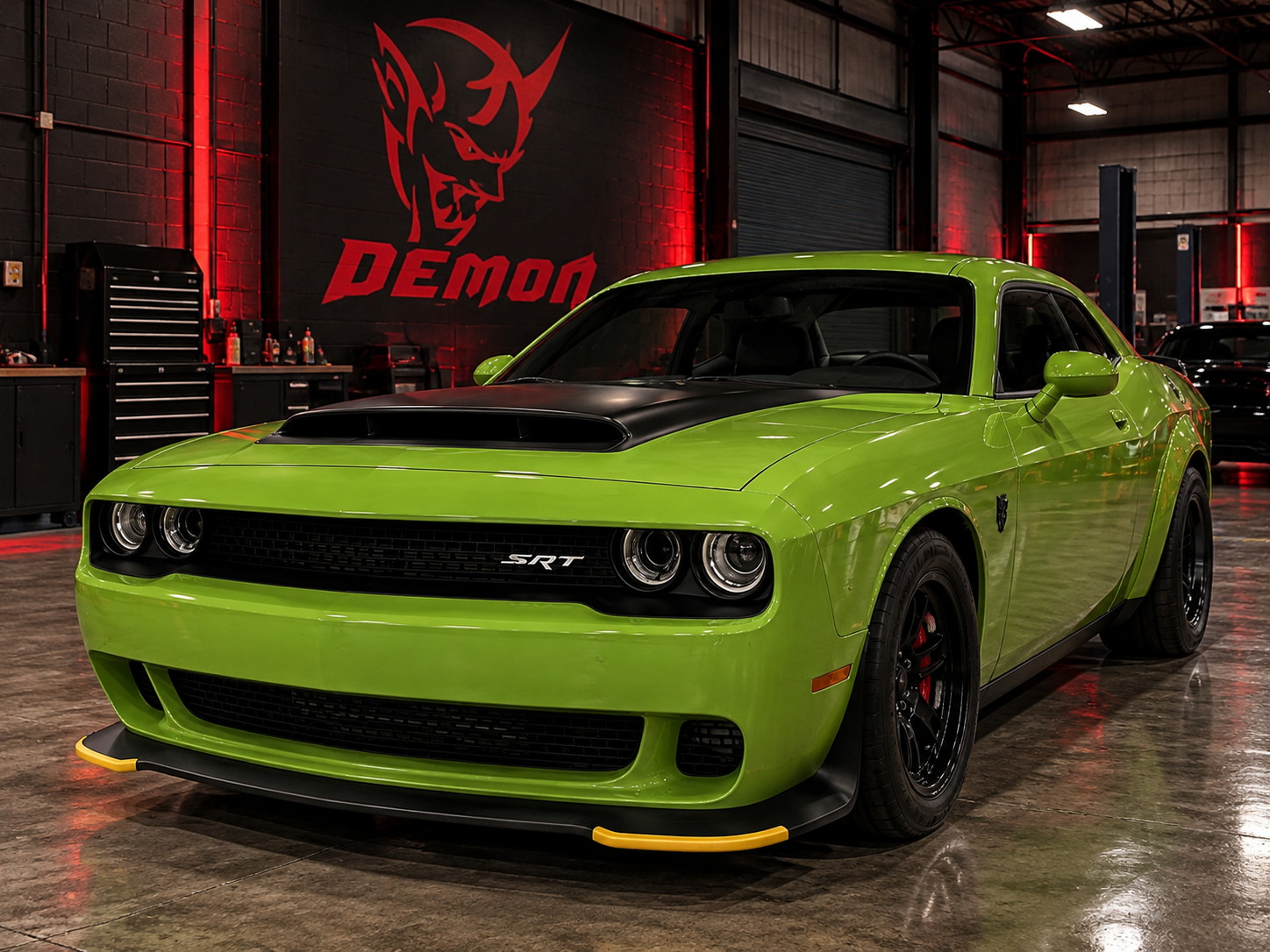
FCA revealed the Challenger SRT Demon on April 11, 2017, for the 2018 model year. Its development brief emphasized quarter-mile performance. The supercharged 6.2-liter HEMI used a 2.7-liter blower, quoted 14.5-psi boost, strengthened components, two dual-stage fuel pumps and intake paths through the hood, headlamp and wheel-liner area.[3]
The factory supplement specifies 808 hp with the red key and premium fuel. The 840-hp configuration requires the Demon Crate controller and 100-octane unleaded fuel; the associated peak torque is 770 lb-ft. It expressly prohibits leaded race fuel and E85.[4]
The distinction is essential when evaluating a used car. A controller in the trunk does not prove it is installed. An installed controller does not establish the fuel in the tank. “840 horsepower” is a configuration-dependent specification, not a promise that follows the car regardless of how it is operated.
Drag development also changes the engineering priorities. The launch needs traction, controlled torque delivery and a driveline able to accept both. The return road and staging lanes then present a cooling problem. A single impressive run is easier to arrange than a package that lets an owner return, prepare and repeat it.
Launch controls and the cooling circuit
Torque Reserve builds boost before launch by closing the supercharger bypass and managing combustion. TransBrake holds the transmission output while the engine loads the driveline. Drag Mode tunes adaptive Bilstein dampers for rearward load transfer, supported by softer springs and anti-roll bars than the Hellcat.[3]
Power Chiller diverts air-conditioning refrigerant to the charge-air cooling circuit. After-Run Chiller keeps the fan and low-temperature pump operating after shutdown. The supplement separately identifies Line Lock, Launch Control and Launch Assist: their functions should not be conflated with TransBrake.[4]
The controls address different stages of the job. Preparing the rear tires is not the same as managing a launch. Loading the driveline is not the same as correcting wheel hop. Treating them all as launch control hides what Dodge actually engineered and makes it harder to interpret the setup used for a timed run.
The original tire specification was 315/40R18 Nitto NT05R drag radials at all four corners. Dodge removed more than 200 pounds of equipment, including seats, insulation and trim. Optional equipment could restore some of that mass.[3]
A fully trimmed car and a driver-seat-only car can both be authentic. They do not necessarily have the same mass or the same job. Nor should specialized drag tires be confused with all-weather touring equipment simply because the vehicle is road legal.
The Demon Crate, ordering and production
Dodge’s U.S. ordering release quoted $84,995 including the $1,700 gas-guzzler tax, but excluding $1,095 destination. The Demon Crate cost $1. Those are original ordering figures, not October 2026 values.[5]
The Crate contained a high-octane controller and switch bank, air filter, narrow front wheels, mirror block-off plate and tools. It was separately supplied equipment. Confirm the contents, delivery records and installed parts rather than assuming a wooden box proves completeness.[4]
FCA documented a one-model-year program of 3,300 cars, allocated 3,000 to the U.S. and 300 to Canada. Its special final-car announcement included build sheets and Certicard in an authentication package. That final-car package should not be assumed to describe every ordinary delivery.[6]
Dodge allowed passenger seats and trunk carpeting to be added back for $1 each. Leather, additional audio equipment and a sunroof were among the other options. Original factory specifications therefore varied meaningfully within the limited run.[20]
A production total is not a count of surviving cars. A market allocation is not a tally of cars currently residing in that country. A build number is not proof of untouched paint. Collector research becomes more useful when these distinctions remain visible instead of being folded into a single claim of rarity.
Factory passes and independent evidence
Dodge advertised 2.3 seconds to 60 mph and an NHRA-certified 9.65-second quarter-mile at approximately 140 mph. Certification of one factory pass is not an independent magazine test or a guarantee for another car on another surface.[9][7]
MotorTrend’s firsthand report describes the factory record setup with a prepared strip, narrow fronts, rear slicks, 100-octane fuel and cool conditions. At the hotter Indiana press drive, its writer reported an onboard-timer 11.0-second best. The track timers were not enabled, so that result is not separately instrumented strip timing.[7]
Kelley Blue Book’s long-term car later ran a reported 10.232 seconds at 135 mph at Famoso, using race fuel, front-runners and the original rear Nittos. It retained its full interior and achieved the best results with a foot-brake launch. That is independent testing with its configuration stated, not a duplicate of the factory record setup.[8]
Weather, surface preparation, tires, weight and technique belong beside the elapsed time. Reaction time belongs in a different column from elapsed time. A quick onboard display is useful feedback, but it does not automatically have the evidentiary weight of a track slip. The distinction is especially important when a launch-event story is later retold as a controlled road test.
2023: the Demon 170 and measured ethanol
Dodge revealed the Demon 170 in March 2023 as the seventh and final Last Call special edition. Its 6.2-liter HEMI was rated at 1,025 hp and 945 lb-ft on high-ethanol fuel, or 900 hp and 810 lb-ft on E10. The name invokes the alcohol-proof designation associated with an 85-percent ethanol blend.[11]
The engine used a 3.0-liter supercharger, 105-mm throttle body and quoted 21.3-psi boost. Dodge detailed stronger clamping arrangements, revised bearings and fueling. TransBrake 2.0 added selectable launch-torque profiles. The 170 was a developed engine-and-driveline package, not simply a 2018 Demon with a different fuel in its tank.[11]
The supplement identifies full power at a sensed ethanol concentration of 65 percent or higher under nominal conditions. Commercial E85 varies seasonally; the controller reads actual composition. Fuel above 85 percent ethanol is not recommended and does not increase the available power.[12]
MotorTrend’s technical overview describes upgraded pistons, rods, crankshaft, bearings, injectors and head fasteners supporting the larger blower. Power reaches the rear wheels through an eight-speed automatic. These materials establish no factory manual-transmission Demon 170.[16]
The fuel distinction between generations is unusually stark. The earlier supplement prohibits E85; the later car monitors ethanol as part of its output strategy. Generic advice for a “Demon” can therefore be wrong even when offered by somebody who has owned one. Model year and exact powertrain matter.
The 170 chassis and its launch equipment
The 170 wore rear 315/50R17 Mickey Thompson ET Street R tires and front 245/55R18 ET Street tires, with rear-only widebody flares. Its stronger rear-drive hardware and optional carbon-fiber/aluminum wheels accompanied the new torque output.[11]
Its supplement documents TransBrake 2.0, Torque Reserve, Line Lock, Power Chiller and cooldown functions, together with specialized tire limitations. These are operating instructions for a particular package, not evidence that every road surface can support its advertised launch.[12]
The taller rear sidewall, tire construction and controlled torque application all address the launch. More power without those changes would risk becoming more wheelspin. The chassis details also explain why apparently modest differences in tire setup can matter more to the first sixty feet than the headline horsepower gap.
Price, advertised performance and the completed run
The 170’s quoted 1.66-second 0–60 time and 8.91-second quarter-mile at approximately 151 mph are manufacturer results on a prepared strip, not an independently measured MotorTrend test. The publication’s separate estimate must not be recast as a recorded result.[16]
Rollout convention, weather, fuel and setup must accompany a comparison. This research does not establish a complete independent Demon 170 test set under conditions matching the 2018 record. No missing acceleration or braking measurements have been invented to fill the gap.
The ordering announcement specified $96,666 before destination and fees and a maximum of 3,300 cars: 3,000 for the U.S. and 300 for Canada. The final total was initially conditional on capacity and components.[13]
American Cars And Racing reported in January 2024 that a Dodge spokesman confirmed all 3,300 planned cars were built. This is later manufacturer confirmation attributed through a reporter, not a RAREREG inspection of the plant ledger.[14]
MoparInsiders’ corrected production compilation describes the 3,300-car run and 300 Canadian examples. It notes that 26 originally counted entries were unbuilt and removed. Its option breakdowns are specialist reporting and should be credited accordingly.[15]
An announced ceiling, a confirmed finished run and a corrected color breakdown are different pieces of evidence. Keeping them separate prevents an outdated production spreadsheet from quietly becoming the basis of a seller’s claim that a car is unique.
2018 Demon vs. 2023 Demon 170
Different price bases and performance conditions make simple subtraction misleading. This table does not compare identically optioned curb weights, zero-rollout acceleration or complete independent test datasets. It is a configuration reference, with the limits stated alongside the numbers.
Street legal and track eligibility are separate
NHRA’s 2017 explanation discussed additional safety equipment at 9.99 seconds or quicker. The “banned Demon” slogan concerned exceeding equipment limits, not an inability to enter an NHRA facility under any circumstances.[9]
The current Street Legal program permits qualifying 2014-and-newer OEM cars down to 9.00 seconds and/or 150 mph under listed conditions. The 170’s advertised 8.91-second run exceeds that elapsed-time allowance. Current event inspection, licensing and rulebook requirements govern a particular car.[10]
Historical marketing is poor technical guidance. The track’s inspection staff, not a remembered launch slogan, determines what equipment is required. Likewise, an accessory harness bar or parachute mount does not establish that the rest of a car meets the applicable class rules.
Authentication, collectibility and the paper trail
Start with the VIN, factory build record, window sticker, original invoice and option descriptions. Compare those records with the actual car. Badges, flares and numbered-looking plaques can be replicated. Keep full VINs private when sharing public registry research; a documentation status can communicate useful evidence without publishing sensitive identifiers.
Inventory a 2018 car’s Crate separately. Establish which controller is installed, retain original components and document alterations. For a 170, confirm the ordered wheel and interior packages and keep dealer-supplied equipment records. A coherent file lets the next owner distinguish what Dodge built from what somebody added.
Condition demands more than an odometer photograph. Ask about track use, tuning, tires, fuel storage, driveline replacements and repairs. Low mileage does not prove gentle use, and honest race history is more informative than a vague claim of investment-grade condition. An inspection should evaluate the machine as well as the paperwork.
The 2018 car introduced the complete modern Demon formula. The 170 extended it through ethanol-compatible engineering and higher output. Their significance lies in those packages and their place in Challenger history. Limited production does not guarantee appreciation; asking prices, ordinary completed sales and exceptional charity transactions should never be treated as interchangeable market evidence.
Status through October 8, 2026
MoparInsiders reported on September 14, 2026 that Dodge CEO Matt McAlear described a Customer Service Notice affecting 345 Demon 170 VINs. The crankshaft damper and bolt issue was traced to a supplier production period. Affected VINs are not necessarily consecutive; Dodge advised transport to the dealer rather than driving those cars.[17]
Road & Track’s September 22 coverage attributes its findings to that reporting. Owners are directed to check the CSN portion of Mopar’s VIN lookup; a clear safety-recall search is not a substitute. This reference cannot establish an individual car’s current campaign status.[18]
A separate FCA bulletin, CSN A6B, hosted by NHTSA concerns spark plugs on certain 2023 6.2L HO Challengers. It does not substantiate the 2026 damper notice. Keep campaign-specific repair records rather than assuming all notices describe the same work.[19]
No successor Demon production commitment is established by this research. Future performance-car discussion, a rendering or a familiar crate-engine name does not announce another Demon model. The useful current work is to preserve the cars’ histories, verify applicable service actions and document their actual configurations rather than attach tomorrow’s speculation to yesterday’s build record.
CITED SOURCES
Sources
- The Demon from Dodge in 1971
Dodge · manufacturer · Accessed
Manufacturer retrospective; origins, engines and name controversy. Not proof of a single cause for renaming.
- 1971 Dodge Scat Pack brochure
Dodge · archived factory literature · factory literature · Accessed
Period Demon 340 standard equipment; archive indexing supports the equipment panel.
- 2018 Demon factory launch
FCA US LLC · April 11, 2017 · manufacturer · Accessed
Engineering and manufacturer performance claims; not an independent magazine test.
- 2018 Demon Supplement, fourth edition
FCA US LLC / Mopar · factory literature · Accessed
Fuel, keys, launch controls, cooling and Crate; locators use printed page numbers.
- 2018 Demon allocation and price
FCA US LLC · June 20, 2017 · manufacturer · Accessed
Historical MSRP and $1 Crate, not current values.
- Final Demon charity announcement
FCA US LLC · April 12, 2018 · manufacturer · Accessed
3,300-unit program and special final-car documents; not a census of surviving cars.
- 2018 Demon First Drive: Exercising Demons
MotorTrend · Chris Walton · technical specialist · Accessed
Firsthand press drive and factory record conditions; event result used onboard timing.
- 2018 Demon long-term ownership review
Kelley Blue Book · technical specialist · Accessed
Firsthand Famoso drag-strip results; race fuel, front-runners, original rear Nitto tires and full interior.
- NHRA explains Demon safety rules
NHRA · technical specialist · Accessed
2017 equipment thresholds and certified factory result, not a blanket current ban.
- NHRA Street Legal program
NHRA · technical specialist · Accessed
Published 2014-and-newer OEM limits and conditions; event inspection still applies.
- Demon 170 factory announcement
Dodge · manufacturer · Accessed
Engine, tires, launch equipment and factory claims; production was initially conditional.
- 2023 Demon 170 Supplement
FCA US LLC / Mopar · factory literature · Accessed
65-percent ethanol threshold, track features and tire limitations.
- Demon 170 ordering announcement
Stellantis North America · manufacturer · Accessed
Price, allocation and conditional production ceiling.
- Dodge confirms 3,300 Demon 170s built
American Cars And Racing · January 5, 2024 · technical specialist · Accessed
Dodge spokesman confirmation of completed production; not an independently audited factory ledger.
- Corrected Demon 170 production breakdown
MoparInsiders · updated February 26, 2026 · technical specialist · Accessed
Specialist compilation corrected to remove 26 unbuilt entries; market and option breakdowns.
- Demon 170 expert review
MotorTrend · Alex Leanse · technical specialist · Accessed
Engine overview and qualified manufacturer claims; its estimated acceleration is not a measured test.
- Service notice for 345 Demon 170s
MoparInsiders · Robert S. Miller · September 14, 2026 · technical specialist · Accessed
Firsthand CEO discussion of damper/bolt issue and transport advice, described as a CSN.
- Demon 170 service-notice coverage
Road & Track · September 22, 2026 · technical specialist · Accessed
Corroborating coverage attributing findings to MoparInsiders, not a second defect investigation.
- FCA CSN A6B: Spark Plugs
FCA US LLC · NHTSA-hosted bulletin · factory literature · Accessed
Certain 2023 6.2L HO Challengers; distinct from the 2026 damper notice.
- 2018 Demon pricing and dollar options
The Drive · Aaron Brown · May 23, 2017 · technical specialist · Accessed
Contemporaneous factory-price reporting: seat, carpet and Crate options.
- 2007 Demon roadster and historical-collection visit
DodgeForum · Patrick Rall · October 11, 2018 · technical specialist · Accessed
Firsthand account of seeing the nonproduction roadster concept in the manufacturer collection.
- 1972 340 net rating context
DodgeGarage · manufacturer · Accessed
Manufacturer-hosted historical account explicitly identifies the 1972 340 rating as net horsepower.