
The most revealing detail about Dodge’s next proposed flagship is a line through an assumption. Look at a low coupe with an aggressive nose and a familiar family resemblance, and it is tempting to start with a Charger and imagine what SRT could remove, widen or supercharge. That shortcut obscures the decision that makes Copperhead worth watching.
In a May interview with The Drive, Tim Kuniskis said the Copperhead does not use Charger hard points. He described the preview’s proportions as production-intent and said it would have a combustion engine, without identifying the engine or platform.[4]
For an enthusiast, that opens a more interesting question than the size of a badge on the fender: how much freedom is Dodge giving its engineers to build a car around the way it should sit, turn and feel? The answer requires hardware. The information available so far establishes intent rather than a finished specification.
Stellantis presented its FaSTLAne 2030 strategy at Investor Day on May 21, 2026. Its North American presentation places performance products within a broader portfolio renewal.[1]
The North America transcript describes SRT as a way to turn existing products into higher-margin halo vehicles across Dodge, Jeep and Ram. Management says the formula depends on leveraging donor-vehicle development and investment. Those are corporate strategy statements, not Copperhead production specifications.[2]
That is a useful constraint. A convincing sports car does not have to begin with a clean sheet, but the reused pieces must suit its mission. Spending less on an established architecture can leave room for cooling, suspension calibration, brakes and durability. Sharing the wrong architecture can instead consume the budget correcting compromises. Copperhead’s eventual donor matters because it will tell us which of those engineering jobs SRT has inherited.
The official North America downloads reviewed here do not publish a named Copperhead engine, price or dated launch commitment. The detailed vehicle descriptions come from journalists who attended the private preview and subsequent interviews.[3]
Kuniskis linked the Charger distinction to its multi-energy packaging: accommodating a battery beneath the floor affects the proportions available to a car built around those hard points. He said SRT must draw on investments elsewhere in Stellantis, but withheld the Copperhead’s donor architecture.[4]
Hard points are the decisions underneath the styling: where major components, occupants and structural interfaces have to go. A lower roof drawn over those constraints does not automatically produce a lower seating position or a smaller car. Moving the bodywork is easier than moving the hardware that supports it.
The engineering questions follow naturally. Where will the driver sit relative to the road? How much mass lies ahead of the front axle? What space is left for tire travel, ducting and crash structure? These are questions for the production reveal, not measurements that can be read from a styling model. They explain why a platform decision deserves at least as much attention as a horsepower announcement.
MotorTrend later proposed the Maserati GranTurismo’s modified Giorgio architecture as a possible starting point. It did not establish that architecture as Dodge’s confirmed choice.[7]
The same interview leaves room for an engine outside the current portfolio. Kuniskis declined to endorse a specific Hemi and was dismissive of the suggested hybrid V8. That does not amount to a complete public powertrain plan.[4]
It would be premature to build a comparison around an imagined output. Cylinder count alone cannot tell us the weight on the front axle, the cooling demand, the response between corners or the transmission’s ability to sustain repeated laps. A spectacular peak figure can coexist with an engine that spends too much of a session protecting itself from heat.
For this particular car, the revealing specifications will include the shape of the torque delivery, the lubrication and cooling arrangements, the gearbox and final drive, and the tires on which any performance claim was measured. None should be filled in with parts borrowed from a different Dodge simply because they would fit the story.
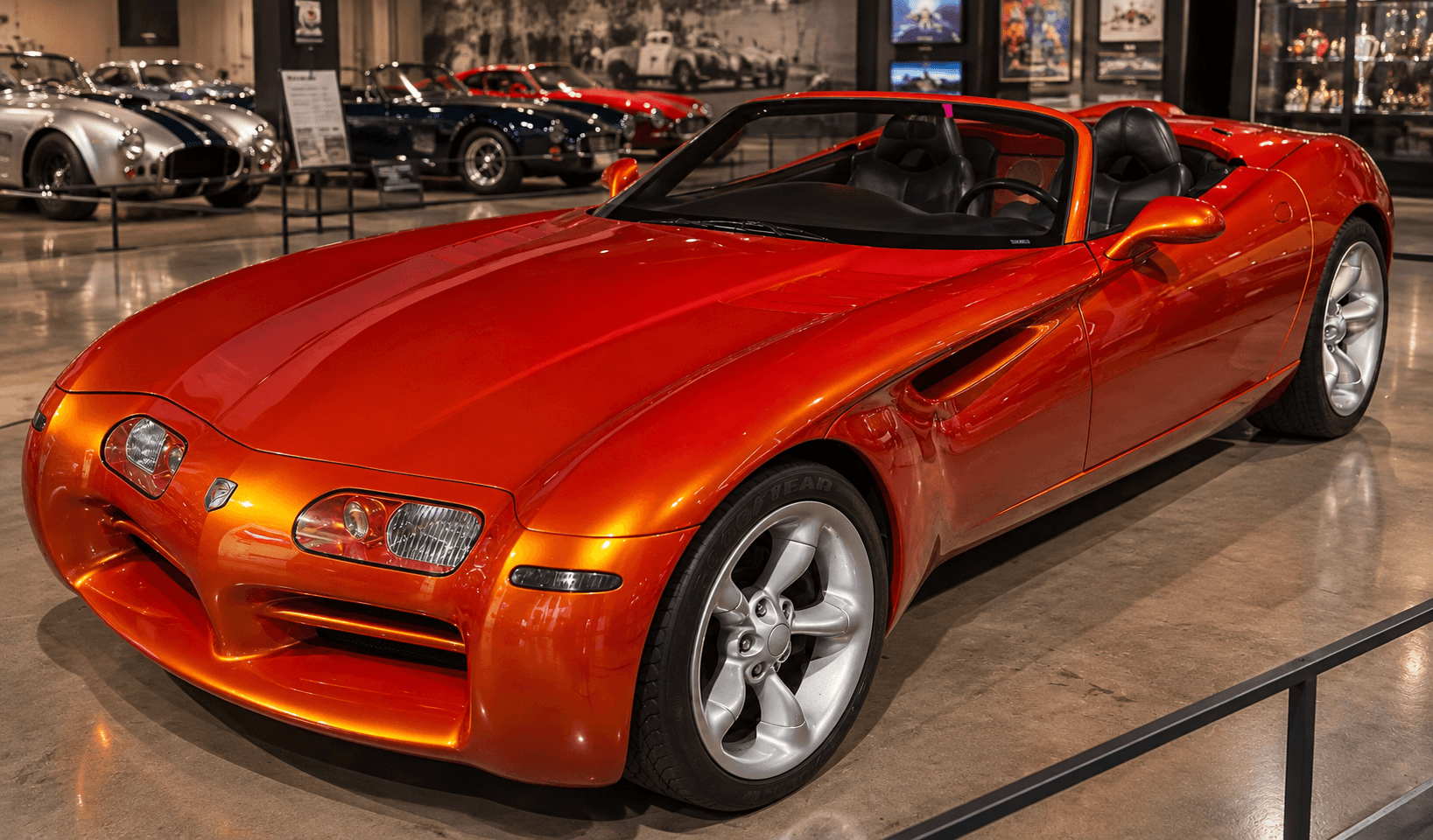
The Copperhead name reaches back to Dodge’s 1997 concept. The Drive’s preview report connects the new model’s stance and rising body lines to that earlier show car, while describing a large splitter, rear wing, fender vents and visible exhaust outlets on the new styling model.[5]
Reviving a concept name carries fewer obligations than reviving a production model, but it still creates expectations. A badge can suggest an attitude; it cannot establish continuity of chassis, powertrain or purpose. The earlier Copperhead is historical context, not an illustrated specification for the proposed SRT coupe.
MotorTrend describes the proposed car as something other than a direct Viper replacement. Its published illustrations were commissioned around an earlier Viper-revival idea, a distinction the magazine explicitly acknowledges.[7]
That distinction matters whenever a future-car image travels farther than its caption. A historical concept photograph, an artist’s proposal and a manufacturer’s production image carry different evidentiary weight. RAREREG will identify them accordingly rather than use one to imply that the finished Copperhead has already been photographed.
Car and Driver initially suggested the 2029 model year as the earliest likely arrival. MotorTrend’s later preview lists 2029 as an expected on-sale date and $100,000 as an estimated price. These are publication estimates, not a Dodge order guide or MSRP announcement.[6]
For a prospective owner, the next useful evidence is straightforward: a production specification, a confirmed delivery schedule, published commercial terms and tests of an identified car in an identified configuration. A styling preview cannot establish build quantity, collectibility or an allocation’s value.
Copperhead’s strongest idea is the opportunity to give Dodge a performance car whose packaging serves its purpose from the outset. Whether SRT has used that opportunity well will be visible in the driving position, chassis behavior and sustained performance. Those are the details worth asking for when the doors finally open on a car customers can buy.
THE EVIDENCE
Sources & scope
- Stellantis Investor Day 2026
Stellantis · manufacturer · Accessed
Official strategic-plan event and source downloads; not a Copperhead specifications release.
Source issued
- Investor Day: North America transcript
Stellantis · manufacturer · Accessed
Pages 4–5: SRT investment, donor products and margin strategy. Does not provide a named Copperhead engine, price or launch date.
Source issued
- Investor Day: North America presentation
Stellantis · manufacturer · Accessed
Official portfolio and SRT strategy. Text search does not name Copperhead; unnamed silhouettes are not vehicle specifications.
Source issued
- Copperhead engine and platform: Tim Kuniskis interview
The Drive · Joel Feder · technical specialist · Accessed
Firsthand interview reporting: no Charger hard points, combustion intent and undisclosed engine/platform. Supersedes initial Charger-based impressions.
Source issued
- The Drive’s private Copperhead preview report
The Drive · Joel Feder · technical specialist · Accessed
Eyewitness styling-model descriptions and 1997 concept context. Its initial Charger-platform assumption is corrected by the May 27 interview.
Source issued
- Copperhead sports-car styling preview
Car and Driver · Caleb Miller · technical specialist · Accessed
Eyewitness model preview. 2029 is an editorial expectation; V8/hybrid suggestions and Charger resemblance are not confirmed engineering.
Source issued
- MotorTrend’s Copperhead future-car report
MotorTrend · Frank Markus · technical specialist · Accessed
Later reporting, estimated timing/price and proposed architecture. Its Maserati/Giorgio discussion is a hypothesis; illustrations are not official Copperhead photography.
Source issued